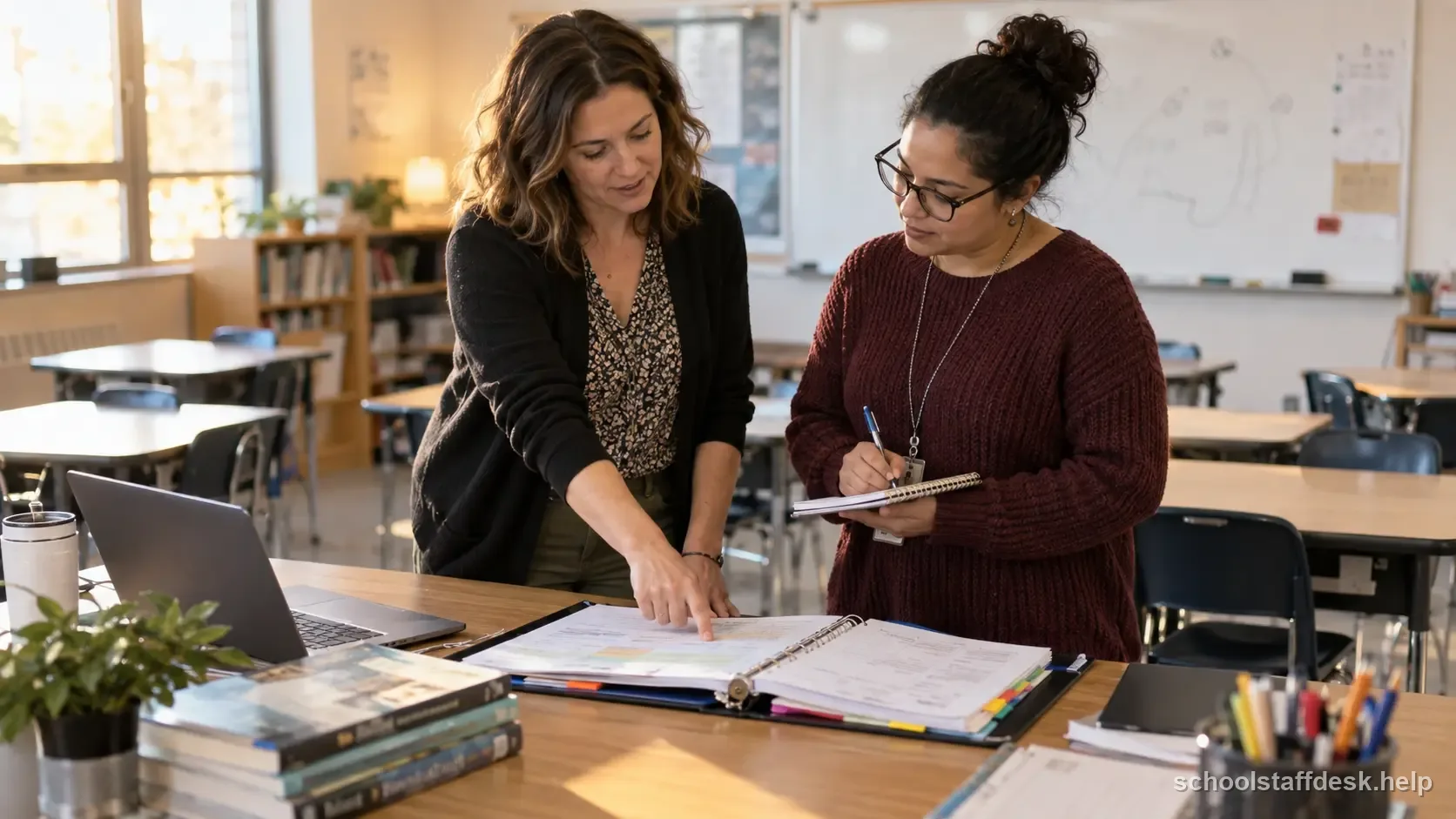
What co-teaching actually means, as a starting definition
The familiar six-model framework is associated with Marilyn Friend and Lynne Cook's work on collaboration between general and special education teachers. In practice, schools use the terms somewhat differently. The useful distinction is whether both educators have a planned instructional role and shared responsibility for access and learning—not simply whether two adults are in the same room.
Treat the models as a menu for planning, not a ladder of quality or a requirement to use all six. A team can deliberately choose a simple structure for a particular lesson, then review whether both adults had meaningful work and students could participate. The model does not replace the student's documented services, each teacher's professional responsibilities, or local scheduling and supervision rules.
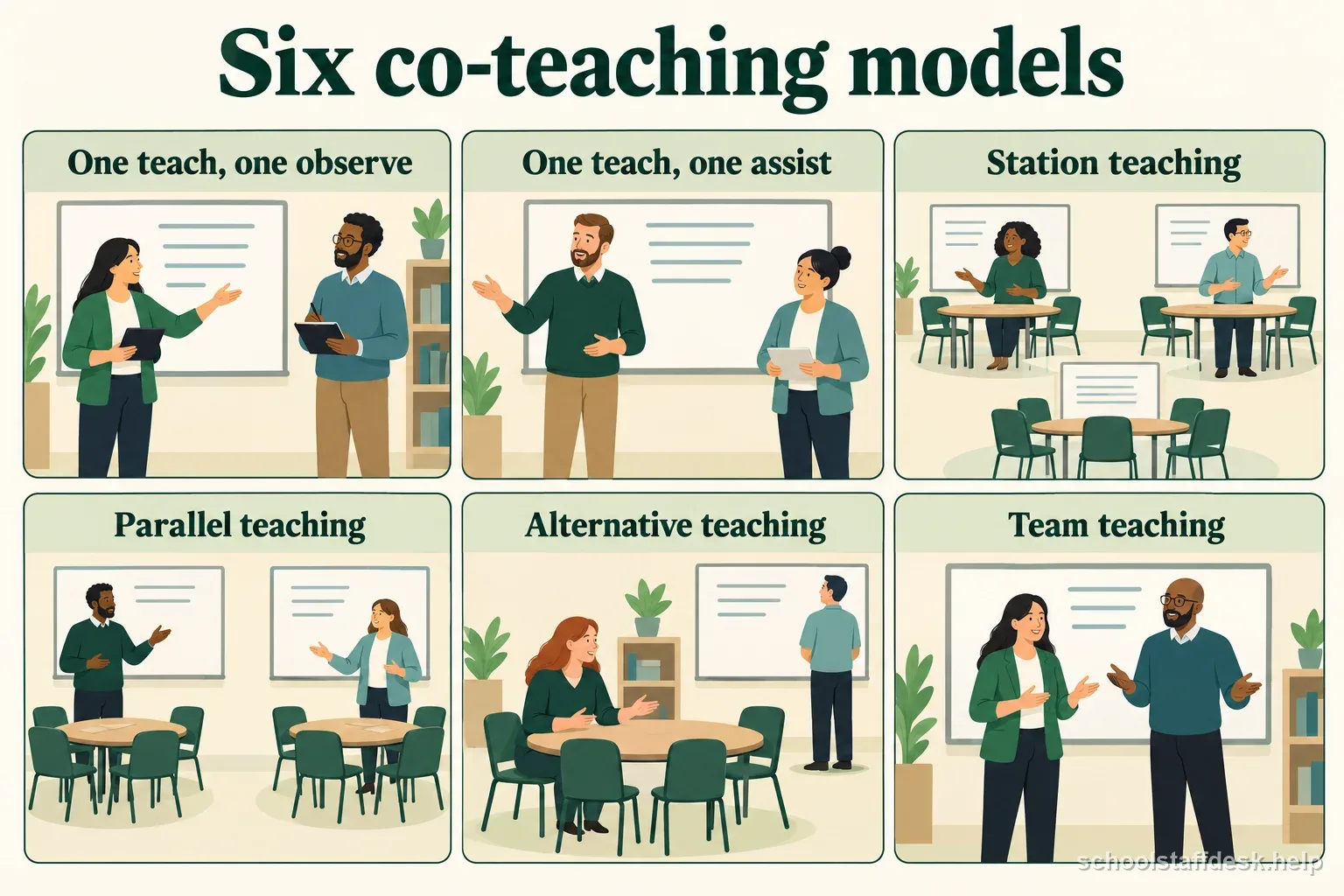
One Teach, One Observe
One teacher leads while the partner gathers information tied to a question the pair agreed on—for example, whether students can follow a new visual direction or which step of a worked example causes errors. Decide in advance what to notice and how the notes will be used. Follow school privacy and recordkeeping rules; avoid collecting identifiable student information on a personal device or creating an unapproved student file. Debrief and switch roles when the observation purpose is met.
One Teach, One Assist
One teacher leads the lesson while the partner moves through the room to prompt, clarify directions, or check understanding. Name the partner's instructional focus before class—such as checking every group's response or reinforcing a strategy—so assistance is purposeful and does not turn into a permanent helper-versus-lead-teacher split. It can be a practical short-term structure, but the pair should review whether it is still meeting the lesson's needs.
Station Teaching
Teachers plan separate stations, and students rotate among them; one station may be independent or use a tool rather than an adult. This fits when the objective can be practiced through distinct tasks and the class can move safely and smoothly. Decide rotation time, directions, materials, and what students do if they finish early. If tasks depend on a fixed sequence, station rotation may add transitions without helping learning.
Parallel Teaching
The teachers split the class into two groups and teach the same objective at the same time. Groups do not have to be exactly equal; plan them around the task, space, and support students need. This can give more learners a chance to answer or practice, but both teachers need aligned directions and materials, and the room must allow groups to work without disruptive sound overlap.
Alternative Teaching
One teacher works with most of the class while the other teaches a smaller group a different but connected task, such as previewing vocabulary, reteaching from recent evidence, or extending the same objective. Plan a clear reason and short review point for the grouping. Vary membership as the learning need changes; repeatedly assigning the same students can stigmatize them or narrow access to the main lesson.
Team Teaching
Both teachers take an active role with the whole group, building on one another's ideas, modeling a dialogue, or sharing parts of an explanation. Agree on transitions and cues so the conversation stays clear rather than competing for attention. This can make shared responsibility visible, but it is not automatically the best option; the lesson and the pair's preparation should make two simultaneous voices useful.
| Lesson task | Model to try | Planning guardrail |
|---|---|---|
| Collect evidence on one question | One teach, one observe | Name the question, record method, and debrief. |
| Prompt during the same lesson | One teach, one assist | Give the assisting teacher a defined instructional focus. |
| Teach distinct tasks in rotations | Station teaching | Plan transitions, directions, and an independent task. |
| Give more response time on one target | Parallel teaching | Align examples, wording, and the exit check. |
| Offer a short connected re-teach or extension | Alternative teaching | Vary group membership and reconnect to the shared goal. |
| Model a shared explanation or dialogue | Team teaching | Agree on cues so instructions do not compete. |
How to actually choose a model for a specific lesson
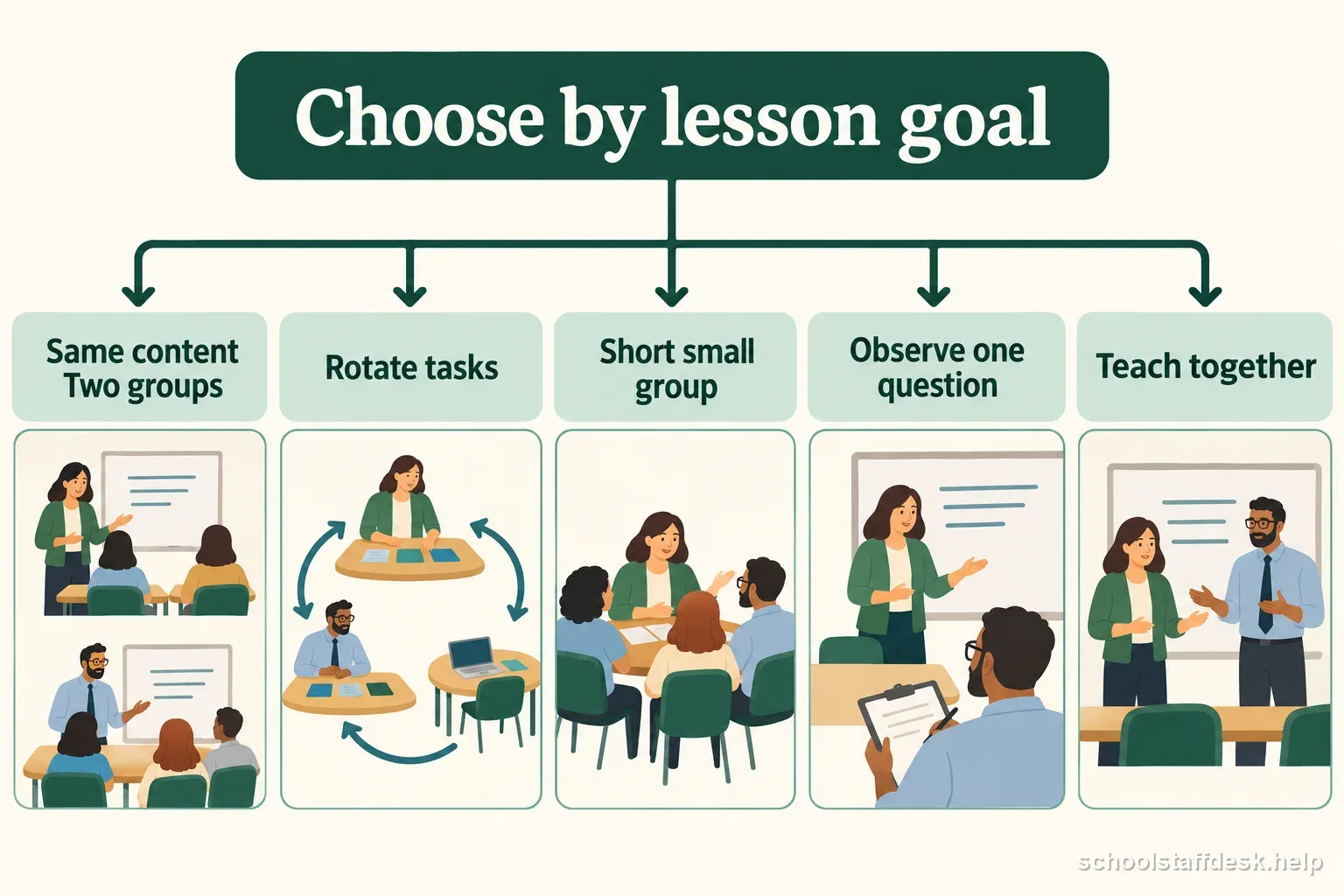
Start with the outcome: Do students need the same explanation, more response opportunities, distinct stations, a short targeted lesson, or a planned observation? Then check room acoustics, transition time, materials, accessibility, and which adult is prepared to lead each part. For example, a discussion may benefit from parallel groups if a quieter room is available; a process with several independent steps may suit stations; a focused check of a new scaffold may justify observing for a short, defined interval.
Before a unit, agree on a small set of likely structures and who will prepare each part. Before a lesson, confirm the objective, groupings, directions, and a quick signal for changing course if time or student response differs from the plan. Afterward, ask who taught, who responded, and what evidence suggests the structure helped. Rotate roles and groups based on the instructional purpose, not a fixed label attached to particular students.
After the lesson, use a two-question reset: which learners had a chance to show the target skill, and what will each teacher do with the evidence? A quick note can capture the model used, the student task, the misconception or strength observed, and the next instructional move. If one teacher repeatedly circulates while the other owns every explanation, switch roles in the next lesson or choose a model that uses both adults to teach. This is a practical partnership check, not a claim that one co-teaching arrangement is always best.
The six models at a glance
| Model | Basic structure |
|---|---|
| One Teach, One Observe | One leads instruction; the other collects specific data |
| One Teach, One Assist | One leads instruction; the other circulates providing individual support |
| Station Teaching | Class rotates through stations, each led by a different teacher |
| Parallel Teaching | Class splits in two; both teachers teach the same content simultaneously |
| Alternative Teaching | One teaches the larger group; the other works with a smaller targeted group |
| Team Teaching | Both teachers instruct the whole group together in real time |
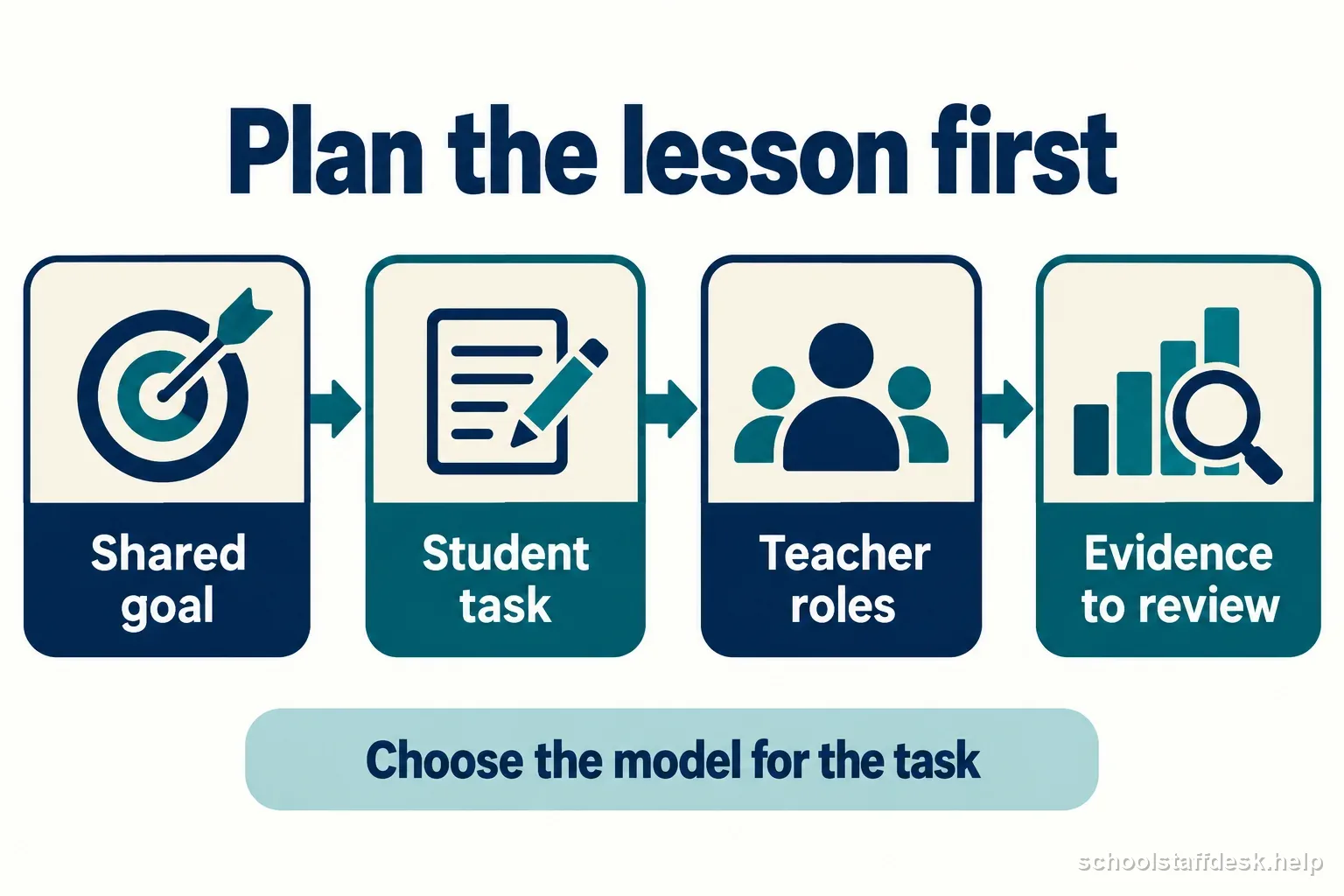
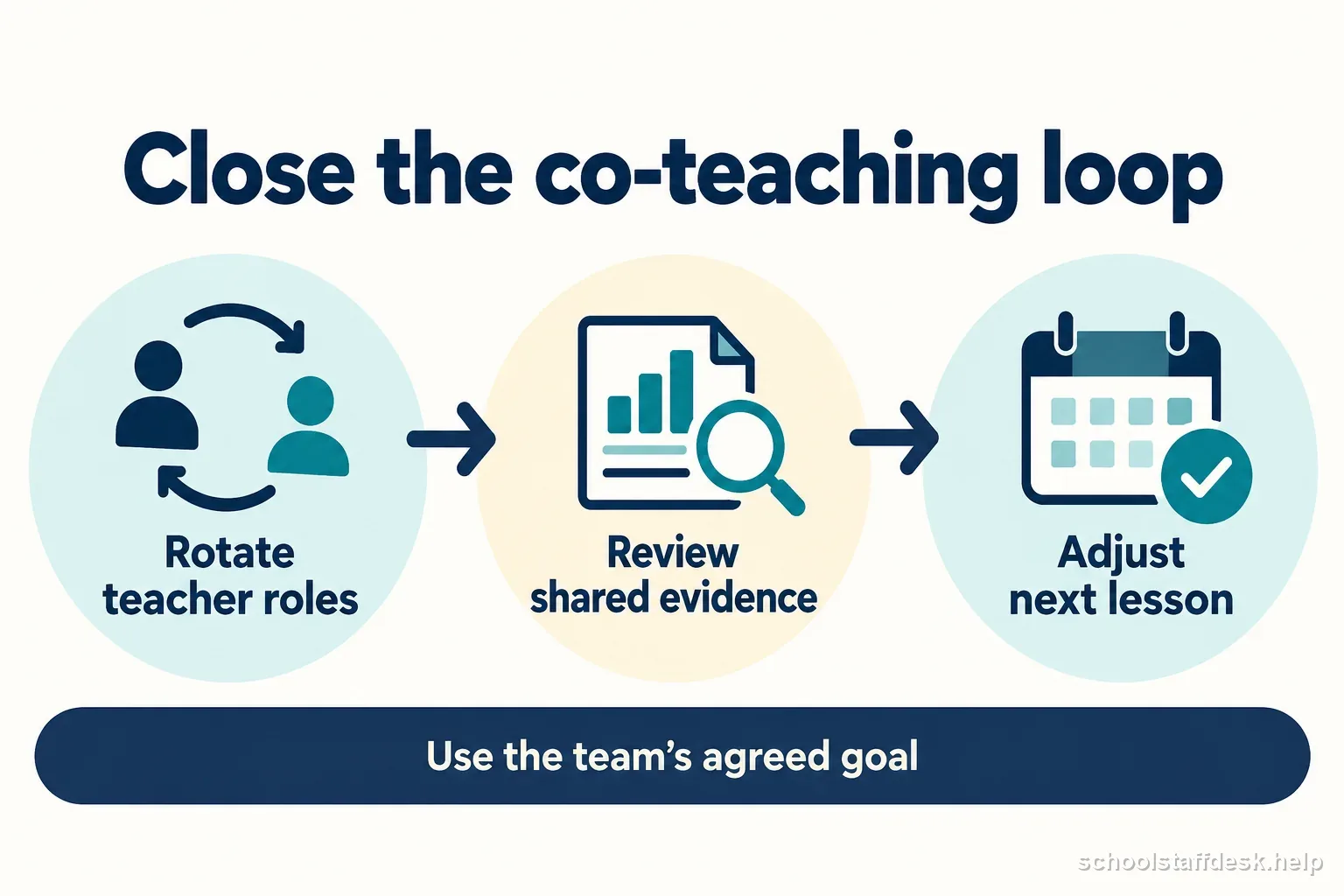
- Plan togetherAgree on the lesson goal and each teacher’s role.
- Match the model to the lessonChoose how students will be grouped and supported.
- Check the resultUse what happened in the lesson to adjust the next plan.
Use lesson examples to keep the partnership practical
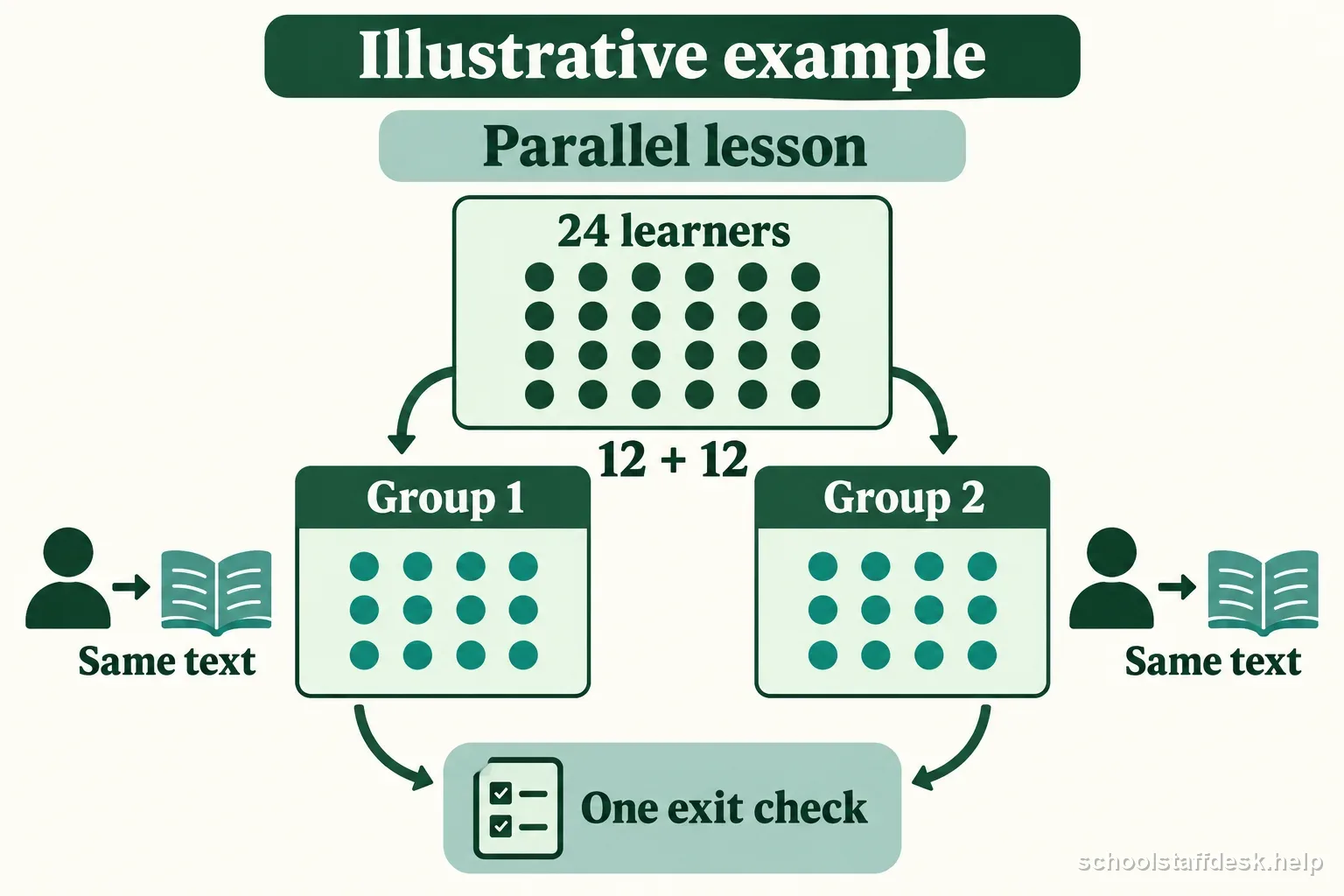
Example 1: parallel teaching for a shared reading target. Suppose 24 learners need more chances to explain a claim. Split the class into 2 groups of 12 (24 ÷ 2 = 12). Both teachers use the same passage, target question, think time, and exit prompt; each notes whether learners cite the text. After class, compare the exit responses. This is illustrative, not a class-size rule. Keep groups flexible and preserve each learner's access supports.
Example 2: station teaching for evidence practice. In a 48-minute block, 30 learners rotate through 3 groups of 10: close reading, vocabulary, and an independent evidence sort. Three 10-minute rounds use 30 minutes; two 2-minute transitions add 4; a 5-minute launch and 5-minute exit check bring the plan to 44 minutes, leaving a 4-minute buffer. This is illustrative, not a pacing rule. Prepare accessible directions and a finish task; redesign if an independent station becomes a waiting room.
A usable partnership makes time for planning, agrees on class routines and communication with families, and decides how responsibilities are shared. Put recurring planning time on the calendar if possible; when time is short, use a repeatable agenda: goal, model, materials, roles, and what evidence to check afterward. Both educators should have a way to raise concerns about access, workload, or student response.
Check in periodically about the partnership and the instruction, not only individual student concerns. If one person is routinely relegated to circulating, or a small group never changes, discuss a concrete adjustment with the co-teacher or instructional lead. The aim is not to force a different model each week; it is to make a deliberate choice and revisit it when the evidence or conditions change.
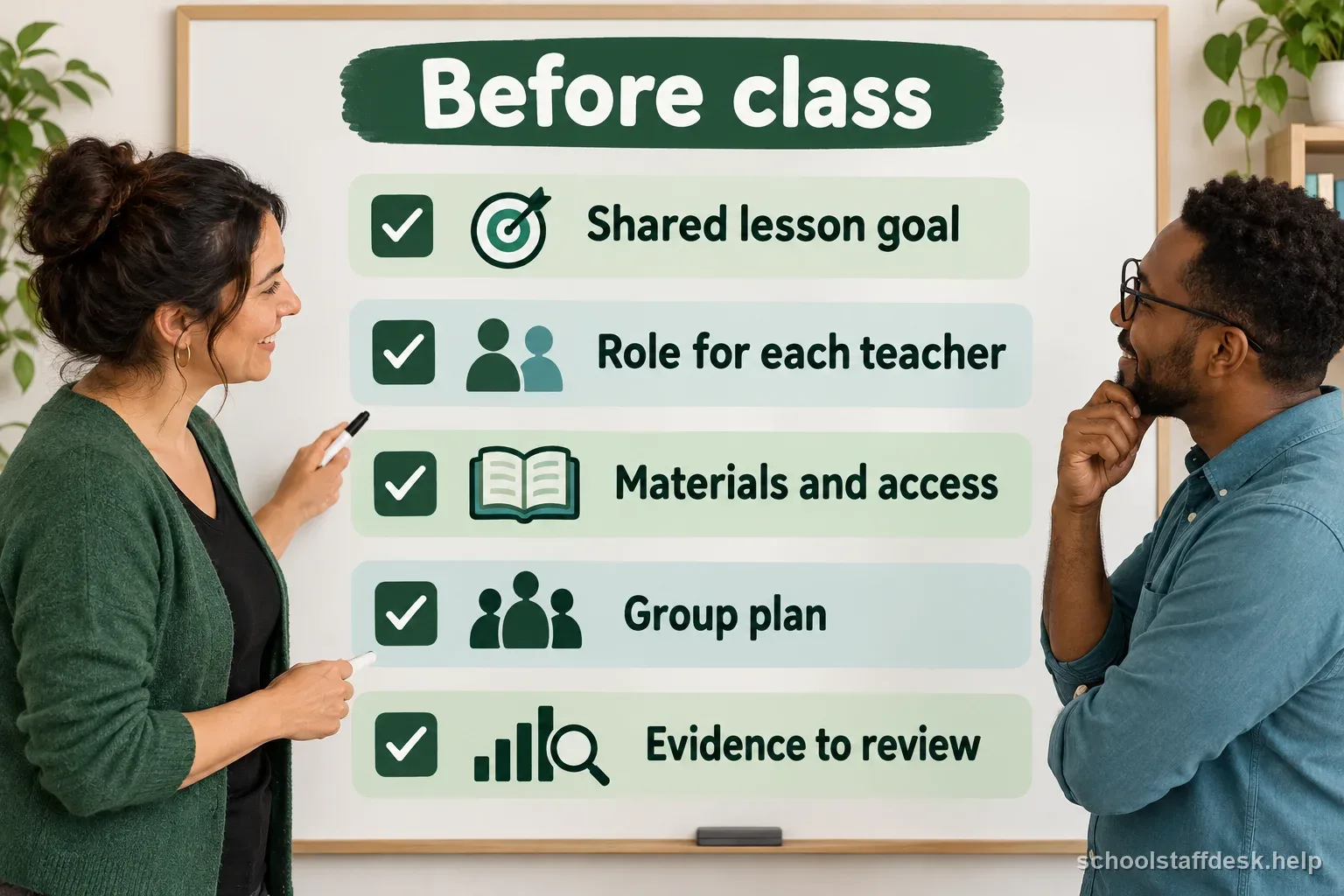
- Name one shared lesson goal.
- Give each teacher a planned instructional role.
- Check materials, access supports, and group directions.
- Choose one piece of evidence to review afterward.
| Example | Group plan | Time check | Shared evidence |
|---|---|---|---|
| Parallel reading | 24 learners: 2 groups of 12 | Same passage and 1 exit prompt | Compare use of text evidence |
| Station practice | 30 learners: 3 groups of 10 | 44 of 48 minutes planned | Review station work and transitions |
Sources used for this guide
- CT SERC — Six Approaches to Co-Teaching
- Texas Education Agency — Co-Teaching Approaches
- Council for Exceptional Children — Co-Teaching Practices that Improve Student Outcomes: The Six Approaches Are Not Enough
- CAST — What Is Co-Teaching? An Introduction to Co-Teaching and Inclusion
Rules can change. Use these sources as a starting point and confirm any state, district, student-plan, employment, licensing, or retirement requirement with the agency or team that governs your situation.
Questions school staff ask about this situation
Who developed the six co-teaching models?
The six approaches are associated with the collaboration framework described by Marilyn Friend and Lynne Cook. Schools may adapt the terminology, so confirm how your team uses the labels.
Is one co-teaching model better than the others?
No — the six models are tools for different situations, not a ranked hierarchy. Effective co-teaching pairs typically move between models depending on the content, student needs, and available planning time.
Which co-teaching model requires the most joint planning?
There is no universal ranking for planning demand. Team teaching usually requires both educators to coordinate cues and share whole-group instruction, while station teaching requires preparation of separate tasks and transitions. The lesson and pair determine which is more demanding.
Why is One Teach, One Assist so commonly overused?
It can be quick to arrange, but the model itself does not show whether it is overused. Agree on the assisting teacher's instructional focus and review whether the structure gives both educators meaningful roles and students the support they need.
How often should a co-teaching pair change models?
There is no required weekly rotation. Choose a structure for the lesson goal, then change it when the task, student response, room conditions, or access needs call for a different arrangement. Review whether both teachers had an active role.