Who actually qualifies
To claim the educator expense deduction, you must work as a teacher, instructor, counselor, sports administrator, coach, principal, or aide, work with students in kindergarten through grade 12, and complete at least 900 hours of work during the school year at a school that provides elementary or secondary education under state law. A part-time aide or coach who clears the 900-hour threshold qualifies exactly the same as a full-time classroom teacher; the hours requirement, not job title alone, is what controls eligibility.
The current dollar limit
The above-the-line educator expense deduction rose to $350 for the 2026 tax year, up from the long-standing $300 figure. Married educators who both qualify and file jointly can deduct up to $700 combined, capped at $350 per person — one spouse cannot claim the other's unused portion.
Beginning with the 2026 tax year, there's also a new option: after taking the $350 above-the-line deduction, an educator can additionally itemize further qualifying classroom expenses beyond that amount on Schedule A, with no dollar cap on that itemized portion. This only helps if you already itemize rather than take the standard deduction, since the itemized portion only has value stacked on top of other itemized deductions that clear the standard deduction threshold.
What actually counts as a qualifying expense
Qualifying expenses include books, classroom supplies, computer equipment including related software and services, other classroom equipment, and supplementary materials actually used in the classroom. Professional development course fees also qualify, which is a detail many teachers miss — a paid conference or continuing-education course directly related to your teaching assignment can be included alongside physical supplies.
The deduction is for unreimbursed expenses only. If your school or PTA reimbursed you, or if the purchase was made with grant or crowdfunding-platform money designated for the classroom, that portion doesn't count — only money that actually came out of your own pocket and was never reimbursed.
What counts toward the deduction
- Classroom supplies you purchased and were never reimbursed for
- Books and supplementary curriculum materials used with students
- Computer equipment, software, and related services used for teaching
- Professional development course fees related to your teaching assignment
- PPE and classroom health supplies (in years the IRS has explicitly included them — verify current-year guidance)
Keep the receipts, and keep them separated by category
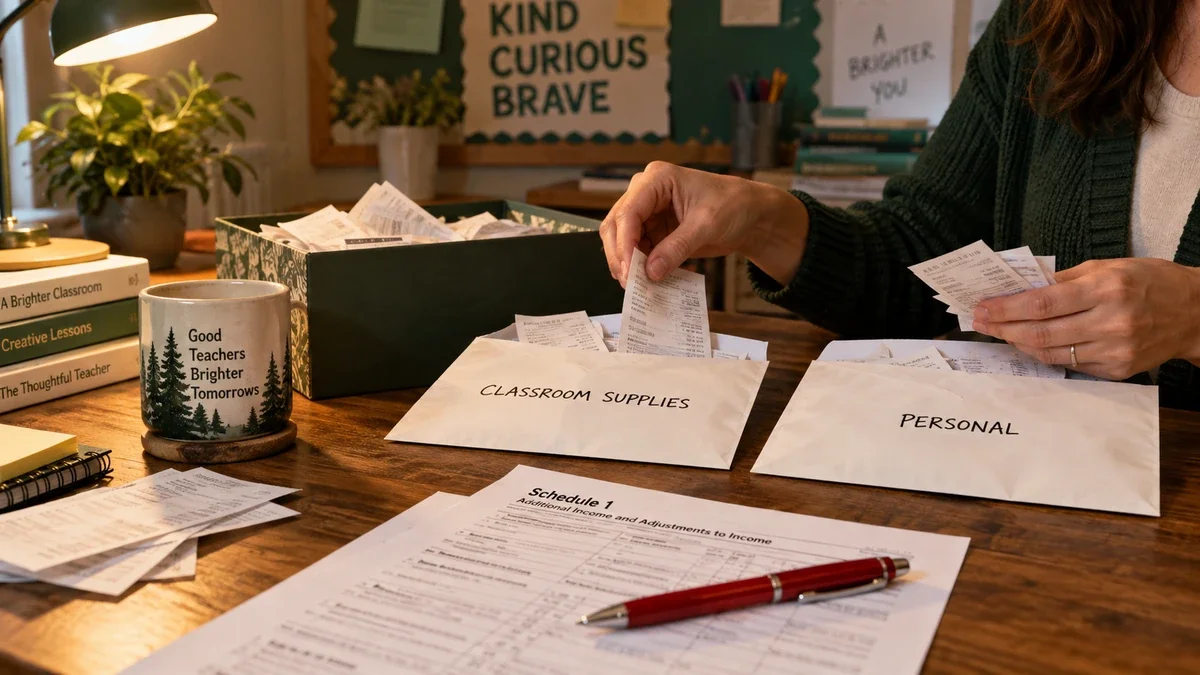
The IRS does not require documentation submitted with your return, but does require you to be able to produce it if asked. Keep receipts specifically for classroom purchases separate from personal shopping receipts throughout the year — waiting until tax season to reconstruct a year of Amazon and Target purchases from memory is where most educators either overclaim or, more often, underclaim and leave money unclaimed.
State-level deductions can stack on top of the federal one
Several states offer their own separate educator expense deduction or credit on top of the federal $350 deduction, with different dollar limits and different qualifying rules — some states mirror the federal definition closely, others are more generous, and some states have no separate provision at all. Check your specific state's department of revenue guidance for educators; a state credit is easy to miss because most tax software surfaces the federal deduction prominently but may bury a state-specific educator provision in a less obvious screen.
How this interacts with a Flexible Spending or district reimbursement account
Some districts offer a small annual reimbursement stipend or allow classroom purchases through a district-managed account. Any amount reimbursed this way is not also deductible — track which purchases were reimbursed and which came fully out of pocket throughout the year, rather than trying to reconstruct the split at tax time from memory. Filing the deduction on expenses that were actually reimbursed is a common, avoidable error that can trigger an IRS inquiry if it's caught.
A common mistake with home-purchased curriculum and subscriptions
Ongoing subscriptions — a classroom management app, a digital curriculum platform, a printable-resource subscription — qualify the same as a one-time purchase as long as they're used for your classroom and unreimbursed, but they're also the easiest category to lose track of because the charge repeats monthly rather than showing up as a single receipt at tax time. Export a full year of statements from any recurring classroom-related subscription rather than trying to recall which months you actually used it for teaching versus personal use.
This deduction is separate from any state salary-schedule stipend for supplies
Some districts and states provide a small annual classroom-supply stipend as part of compensation, separate entirely from the federal tax deduction discussed here. A stipend is income you received and then spent; the federal deduction is for money you spent that was never reimbursed by anyone. Don't assume a district stipend replaces or duplicates the deduction — they address different situations, and a teacher who both received a small stipend and spent additional unreimbursed money out of pocket can potentially benefit from both, as long as the deducted expenses weren't the same dollars covered by the stipend.
Home internet and phone used partly for school work
A portion of home internet or phone expense used specifically for classroom-related work — accessing the district's learning management system, communicating with families after hours — is a gray area many teachers assume qualifies fully but which the IRS treats more cautiously than a direct classroom-supply purchase. General guidance ties the deduction to supplies and equipment used in the classroom rather than home-office-style shared-use expenses; when in doubt on this specific category, consult a tax preparer familiar with educator deductions rather than assuming the full home bill qualifies.
Sources used for this guide
Rules can change. Use these sources as a starting point and confirm any state, district, student-plan, employment, licensing, or retirement requirement with the agency or team that governs your situation.
Questions school staff ask about this situation
Do substitute teachers qualify for the educator expense deduction?
Only if they meet the 900-hour requirement for the school year, which is a high bar for most substitutes working sporadic assignments across different schools. Long-term substitutes in a single consistent assignment are more likely to clear the threshold than day-to-day subs.
Can a paraprofessional claim this deduction?
Yes — aides are explicitly included in the list of qualifying roles, as long as the 900-hour and K-12 requirements are met. Job title matters less than meeting both the role category and the hours worked.
What if my total classroom spending was well over $350?
You can still only deduct up to $350 above the line, but starting with the 2026 tax year you can itemize the excess on Schedule A if you itemize deductions rather than take the standard deduction. If you take the standard deduction, spending above $350 currently has no further federal deduction.
Does the deduction apply if I teach at a private school?
Yes, as long as the private school provides elementary or secondary education under applicable state law and you meet the role and hours requirements — the deduction is not limited to public school educators.
What if I teach a mix of grade levels that includes some outside K-12?
The deduction specifically requires working with students in kindergarten through grade 12; time spent teaching outside that range, such as a college course, does not itself qualify, though it also doesn't disqualify your K-12 teaching hours from counting toward the 900-hour threshold.