
Clarify whether you are covering a teacher or becoming the temporary teacher
A long-term assignment may expand beyond following daily plans. You could be asked to plan units, enter grades, attend team meetings, communicate with families, administer common assessments, or participate in conferences. Ask for the written scope before accepting, including who supervises the work and what support and access you will receive. Do not assume that the title alone determines your pay or authority.
District definitions, pay thresholds, benefits, retirement eligibility, leave rules, and credential limits vary by employer and state. Ask HR to confirm the rules for this exact assignment in writing, including what happens if its dates are extended. A district handbook may define a threshold such as 10 or 20 days, but that is a local term, not a national standard.
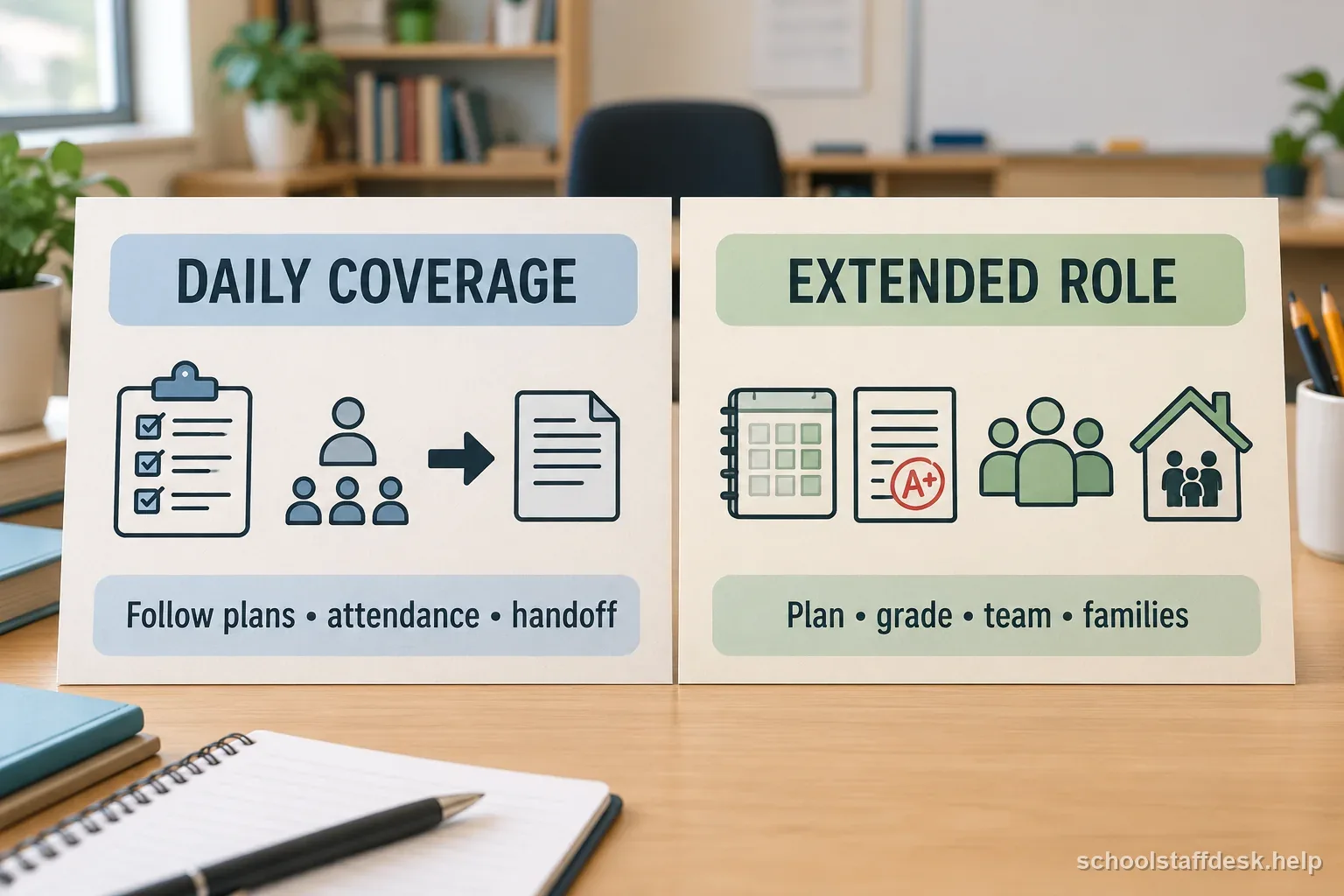
Assignment terms to confirm before day one
| Topic | Ask the district | Keep or confirm |
|---|---|---|
| Dates and role | Who is the assigned teacher or vacancy, and what are the start and expected end dates? | Written assignment notice and extension process |
| Daily duties | Which classes, planning, grading, family contact, meetings, supervision, and extra duties are included? | Duty list and decision-maker for changes |
| Pay and time | What daily or hourly rate applies, when is time submitted, and how are holidays or cancellations treated? | Rate confirmation and payroll contact |
| Access and support | Which accounts and student-plan information are authorized for these duties, and who helps if access fails? | Your own account and named support contact |
| Credential and benefits | Does this assignment require a permit, credential, training, leave enrollment, or benefits action? | HR answer for this role and jurisdiction |
| End of assignment | Who receives records, keys, devices, and the instructional handoff when the assignment ends? | Return checklist and records procedure |
Get system access before responsibility arrives
Request the gradebook, learning-management system, curriculum platform, student information system, staff email groups, shared department drive, and any assessment tools you are authorized to use. Do not borrow another employee’s login. If access is delayed, document the request and ask the administrator how required work should be handled meanwhile.
Also get the pacing guide, current unit plan, recent gradebook status, missing-work policy, accommodation information, and upcoming deadlines. You need a snapshot of where the class actually is, not only where the curriculum map says it should be.
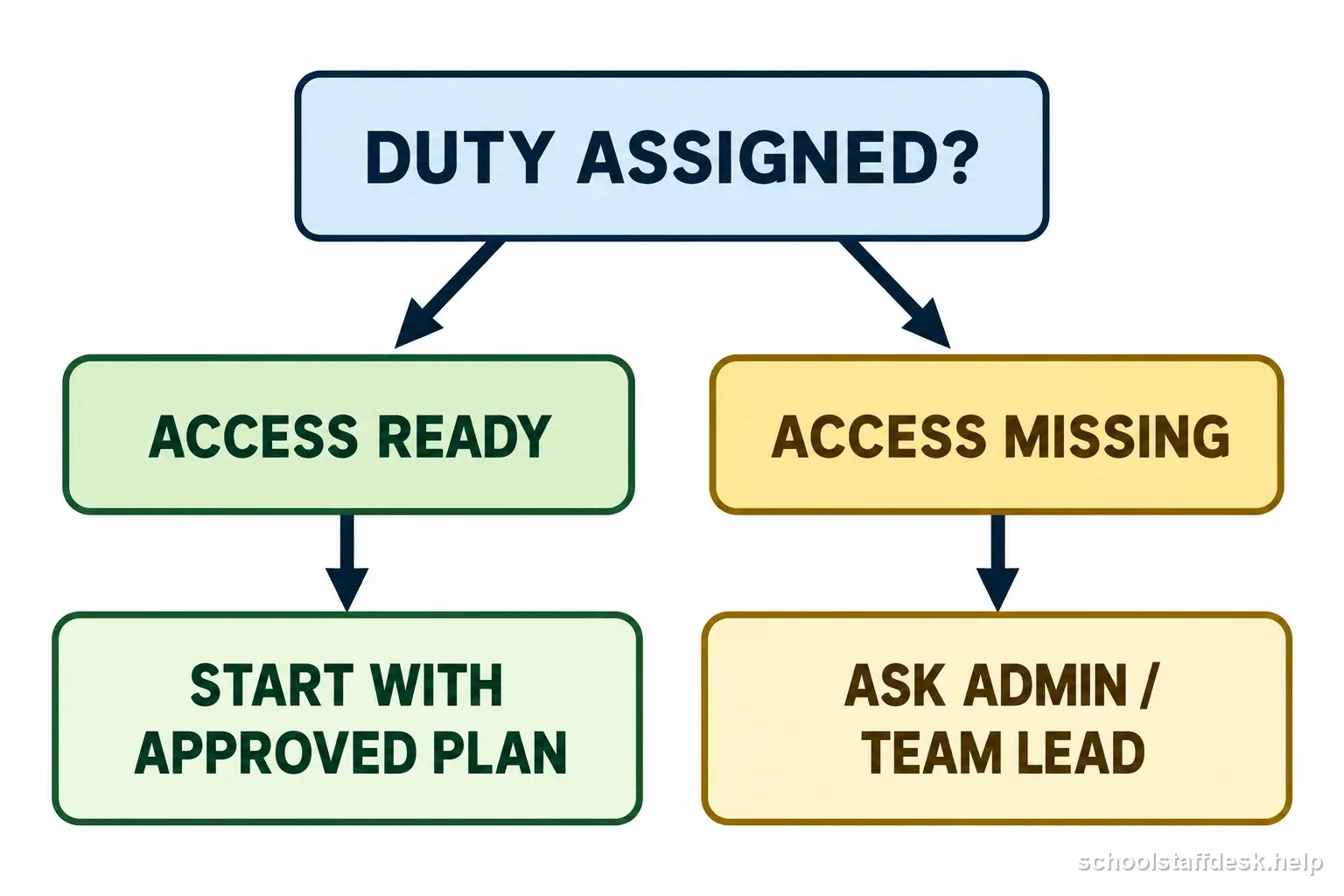
Meet the team in the first two days
Find the grade-level or department lead, special-education case managers, counselor, and administrator who support the class. Ask what is common across the team: assessments, grading categories, late-work rules, family communication, intervention periods, and discipline procedures. Following shared systems reduces the number of decisions you have to invent.
If the regular teacher can provide a handoff, use it, but do not delay basic setup waiting for a perfect transition document that may never come.

Take control of the gradebook carefully
Before entering or changing grades, find out which assignments are complete, which are missing, which students had extensions, and whether any grades are placeholders. Do not “clean up” old entries by assumption. Ask the department or administrator how to handle work assigned before you arrived and work that will be completed after you leave.
Create a predictable grading rhythm for your portion of the assignment and tell students what they can expect. Long-term subs lose trust quickly when the gradebook appears random.

Family communication changes when you are there for weeks
Introduce yourself through the school-approved channel if you will be the primary classroom adult for an extended period. Explain the assignment dates if the district has authorized that information, how families should contact you, and where students find work. Avoid discussing the absent teacher’s private employment or health details.
For conferences or serious concerns, ask what administrator or team member should join. You may be temporary, but family communication still needs the same documentation and privacy standards. Under IDEA, each teacher responsible for implementing an IEP must have access to it and be informed of their specific responsibilities and required accommodations, modifications, and supports (34 CFR 300.323(d)). Section 504 has separate requirements and district processes; ask the 504 coordinator what information and duties apply to your assignment rather than treating the IDEA rule as the 504 rule.
Treat the transfer of systems as evidence for a permanent role
You need more than lesson plans. Ask for curriculum maps, pacing documents, common assessments, gradebook access, learning-management access, parent-contact expectations, IEP/504 implementation information you are authorized to receive, team meeting dates, and the school’s process for missing work and discipline. If the regular teacher is available for a handoff, use the overlap to capture routines that are not obvious from files: how materials move, which deadlines are fixed, and which colleagues own specialized questions.
Clarify employment terms in writing. Districts vary on when a substitute becomes ‘long-term,’ whether the daily rate changes, whether benefits or leave apply, and what credential is required for an extended assignment. Do not build a household budget around an informal promise from another substitute.
If you hope the role leads to a permanent job, document the work a hiring team can legitimately see: reliable planning, student work systems without confidential information, collaboration, attendance, and professional communication. Do not turn student records into a portfolio.
Within the first week, establish a predictable grading and communication cadence. Students should know when work will be returned, families should know who is answering messages, and the department should know whether you are attending common-planning or data meetings. If the regular teacher may return soon, agree on which decisions are temporary and which need the department lead’s approval.
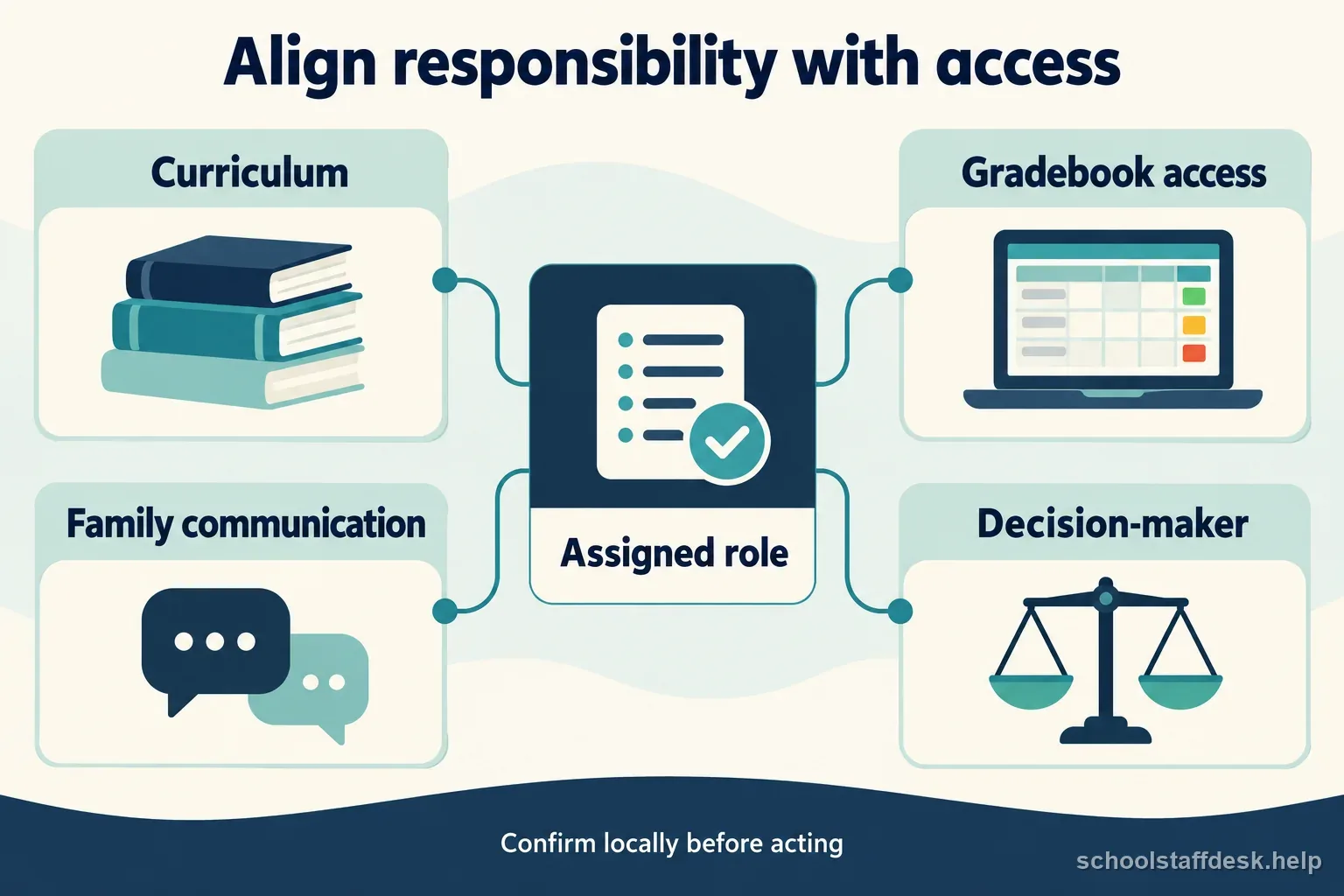
- Get authorized accessUse your own account for the systems your duties require.
- Capture team routinesConfirm grading, missing work, communication, and meeting expectations.
- Set a predictable cadenceTell students and families what to expect through approved channels.
- Document work without student recordsKeep non-confidential planning and professional feedback for hiring evidence.
Use a weekly rhythm to keep the assignment organized
Before accepting a multiweek assignment, request one written handover list naming the curriculum contact, gradebook owner, family-communication expectation, IEP/504 access contact, attendance correction route, assessment calendar, payroll contact, and who approves instructional changes. If the absent teacher is unavailable, ask the department chair or administrator to name the decision-maker. This keeps assigned responsibilities aligned with your access and authority.
Keep examples of your own non-confidential planning, unit maps, assessment design, and professional feedback. Ask for an observation if the district permits it and you want hiring evidence. Be reliable in meetings, deadlines, and communication; the less visible parts of the job are often what principals remember.
Before assuming the long-term role leads to a permanent job, check the district hiring process. A successful assignment can make you a stronger candidate without bypassing credential, posting, interview, or seniority requirements. The guide to substitute unemployment benefits between assignments explains how school-break rules differ from an ordinary gap between calls.
For school-break claim questions, see the guide to teacher unemployment between contract years.
Use a repeatable weekly rhythm instead of carrying every decision in your head. At the start of the week, compare the pacing guide with the actual class calendar, confirm tests and field trips with the team, and identify the materials needed for the next five teaching days. During the week, record what was taught and where the class stopped in the authorized system. At the end, flag unfinished work and ask the grade or department lead what should happen next.
Illustrative gradebook handoff: if a class turns in 28 assignments, your status note might say 21 are graded, 5 are awaiting make-up work, and 2 need a decision under the district’s missing-work rule. That adds to 28, but it does not tell you which policy to apply. Keep identifiable names and scores inside the school-approved system; use the administrator or team lead for policy questions.
If the end date moves, ask who will update the written assignment, how the new dates affect pay or required credentials, and whether the temporary teacher’s authority or system access changes. Do not infer a new benefit, leave, or salary category from the extra days alone. Keep the original and revised terms so payroll and HR can reconcile the assignment.

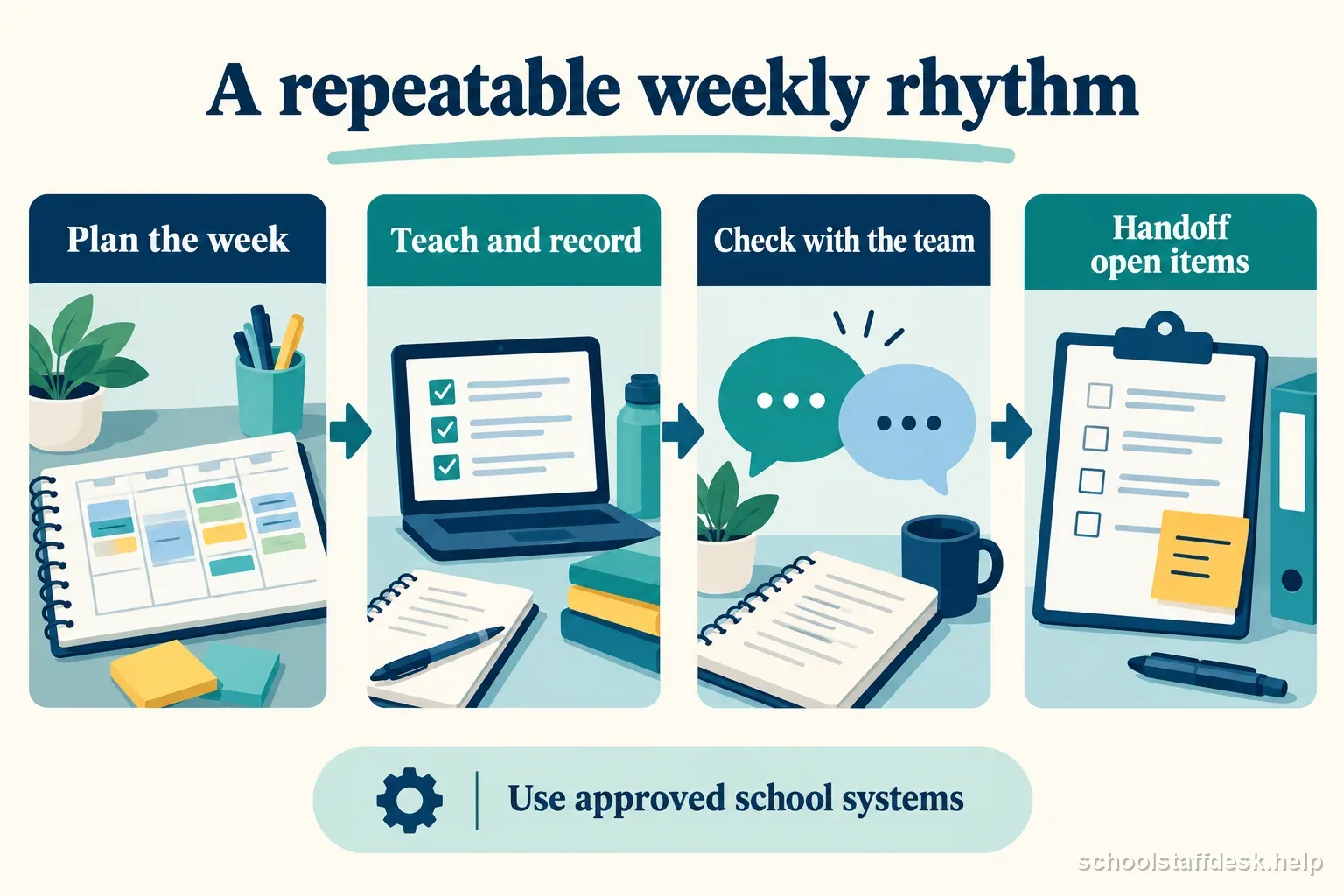
Close the assignment with a clean return handoff
When the regular teacher or a new staff member returns, ask the administrator who should receive the handoff and when access will end. Summarize the current unit, completed and pending assessments, upcoming dates, and any unresolved classroom logistics. Route sensitive student concerns through the school’s approved channel rather than leaving a printed roster or private note on a desk.
A clear handoff protects continuity and gives the returning teacher a reliable starting point. Keep the report factual, use the district system for records, return keys and devices as directed, and delete school material from personal devices only under the district’s instructions. If the assignment ends unexpectedly, contact the administrator for the same closeout steps and payroll contact.
Sources used for this guide
- U.S. Department of Education — IDEA Regulations, 34 CFR 300.323(d)
- U.S. Department of Education — Section 504, FAPE and implementation resources
- Houston Independent School District — Substitute Teacher Need to Know
- Lakewood School District — Substitute Handbook
Rules can change. Use these sources as a starting point and confirm any state, district, student-plan, employment, licensing, or retirement requirement with the agency or team that governs your situation.
Questions school staff ask about this situation
What changes in a long-term substitute assignment?
Long-term subs may take on planning, grading, family communication, meetings, and assessment responsibilities beyond daily coverage. The exact scope, pay, benefits, and credential rules vary by district.
Should a long-term sub get full system access?
You should receive the access required for assigned duties through your own authorized account. Do not use another employee’s credentials to enter grades or view student information.
Who owns grades from before the long-term sub started?
Ask the administrator or department how to handle prior work, extensions, and existing entries. Do not change old grades based on assumptions about what the absent teacher intended.
Can a long-term sub use the job as a path to a permanent position?
Yes, the assignment can demonstrate reliability and teaching skill, but a permanent role still follows the district’s hiring and credential requirements.