
Separate a slow week from a scheduled school break
A few days without a substitute call during an active term is not automatically the same as summer recess. State agencies generally examine a claim under their regular rules when the school is in session, including whether you lost work, are able and available, meet wage requirements, and followed work-search instructions. A break between academic terms can trigger a separate school-worker rule, so identify the actual calendar period and the employer whose wages you are using.
Federal law requires states to apply between-term limits to certain professional services for educational institutions when the worker has a contract or reasonable assurance of doing such work in the next term. It also lets states extend similar limits to other school services. Substitute teachers often perform instructional work, but the employer, wages, role, and state law still matter. Do not treat every call list or gap in assignments as a final eligibility decision.
Your claim can also involve wages outside the school system. If you held a second job, report that employer and all earnings. A school-break limit can apply to school wages without automatically answering whether other covered wages support a claim. Ask the state agency which wages it is using and keep each employer’s wage statement.

What reasonable assurance asks the state to decide
The U.S. Department of Labor says the state agency must decide whether a job is highly probable to be available in the next academic period. It considers the whole record: who communicated the offer, whether that person could speak for the employer, the duties and economic terms, your work history, the employer’s assignment practices, and any conditions attached to the offer. A state may not assume that one letter conclusively proves eligibility or ineligibility.
Contingencies matter. The federal guidance distinguishes circumstances outside an employer’s control, such as enrollment or a specific appropriation, from choices the employer controls, such as deciding how to allocate a general budget or whether to offer a course. The agency also considers whether the offer depends on a condition that is likely to happen. The test is fact-specific; an employer’s label is evidence, not the state’s final determination.
Work offered in the next term is compared with the prior work under the applicable state rule. Record changes in hours, pay, benefits, duties, and the likelihood of assignments. An offer that is substantially less favorable may be treated differently, but the comparison method and thresholds can vary by state. If you worked for more than one school employer, identify each one; federal guidance calls for an employer-by-employer analysis rather than relying on one district’s offer alone.

The state weighs whether an unresolved condition is likely and whether the employer controls it. Undecided course offerings or discretionary budget choices can change the analysis.
State examples show why one answer does not fit every substitute
New York’s Department of Labor describes a specific substitute-list analysis: the list must actually be used to place substitutes, positions must reasonably be expected to exist, and the substitute must expect at least 90% of prior-term remuneration, including wages and benefits. New Jersey says a school need not give a definite return date and generally treats an accepted offer under the same general conditions as reasonable assurance. California’s EDD identifies several separate elements, including school wages, a recess period, attachment to a school employer, and reasonable assurance; its guidance also discusses how non-school wages can matter.
These are examples of state guidance, not a nationwide formula. They do not mean that every New York substitute on a list is disqualified, that every New Jersey call list automatically qualifies, or that a California substitute has no route to benefits. Each state agency applies its law to the actual offer and claim. Use the state where you file, not a rule copied from a neighboring state or a general district email.

| New York | New Jersey | California | |
|---|---|---|---|
| Substitute-list detail | List used to place substitutes; positions reasonably expected; at least 90% of prior-term remuneration expected. | An accepted offer under the same general conditions can establish reasonable assurance. | EDD reviews school wages, recess, attachment, and reasonable assurance. |
| Return-date detail | Check the state guidance and facts of the offer. | A definite return date is generally not required for a substitute offer. | Check the state claim guidance and any applicable notice. |
| What else to verify | List use, expected positions, remuneration, and claim facts. | Whether the offer was accepted and terms are generally the same. | Non-school wages, other eligibility requirements, and any retroactive-payment rule. |
Two examples of how the details can change the question
Illustrative New York comparison: suppose a substitute earned $1,000 in wages and benefits during the prior term. A documented next-term offer worth $900 is exactly 90% of that amount ($900 ÷ $1,000 = 0.90). That reaches New York’s published remuneration comparison only; the list, expected positions, actual terms, and all other claim facts still need review. The arithmetic does not guarantee a benefit decision.
Illustrative multiple-district record: suppose you worked 12 assignment days for District A and 8 for District B in the prior term. District A sends a return notice, but District B does not communicate an offer. Give the agency both districts’ names, assignment dates, and notices. Federal guidance says the state cannot decide a multi-employer claim solely from one employer’s assurance; state law determines how the separate school wages are treated.
Evidence the state may need for a school-break claim
| Question | Useful records | Why it matters |
|---|---|---|
| What kind of gap is this? | School calendar, last assignment, next scheduled term | A slow week in an active term may be treated differently from a break between terms. |
| Who employed you? | W-2s, pay statements, staffing-agency contract, district name | School and non-school wages can be treated differently under state law. |
| Was next-term work actually available? | Offer, return notice, sender’s authority, enrollment or funding conditions | The agency evaluates the likelihood and conditions of the job, not only the label on a letter. |
| How did the terms compare? | Prior and offered hours, pay, benefits, duties, assignment history | State rules may compare the economic terms and the capacity of the work. |
| What did you do after filing? | Weekly certifications, work-search log, earnings and offer records | Ongoing state requirements and appeal deadlines still apply. |
How to file and protect your claim record
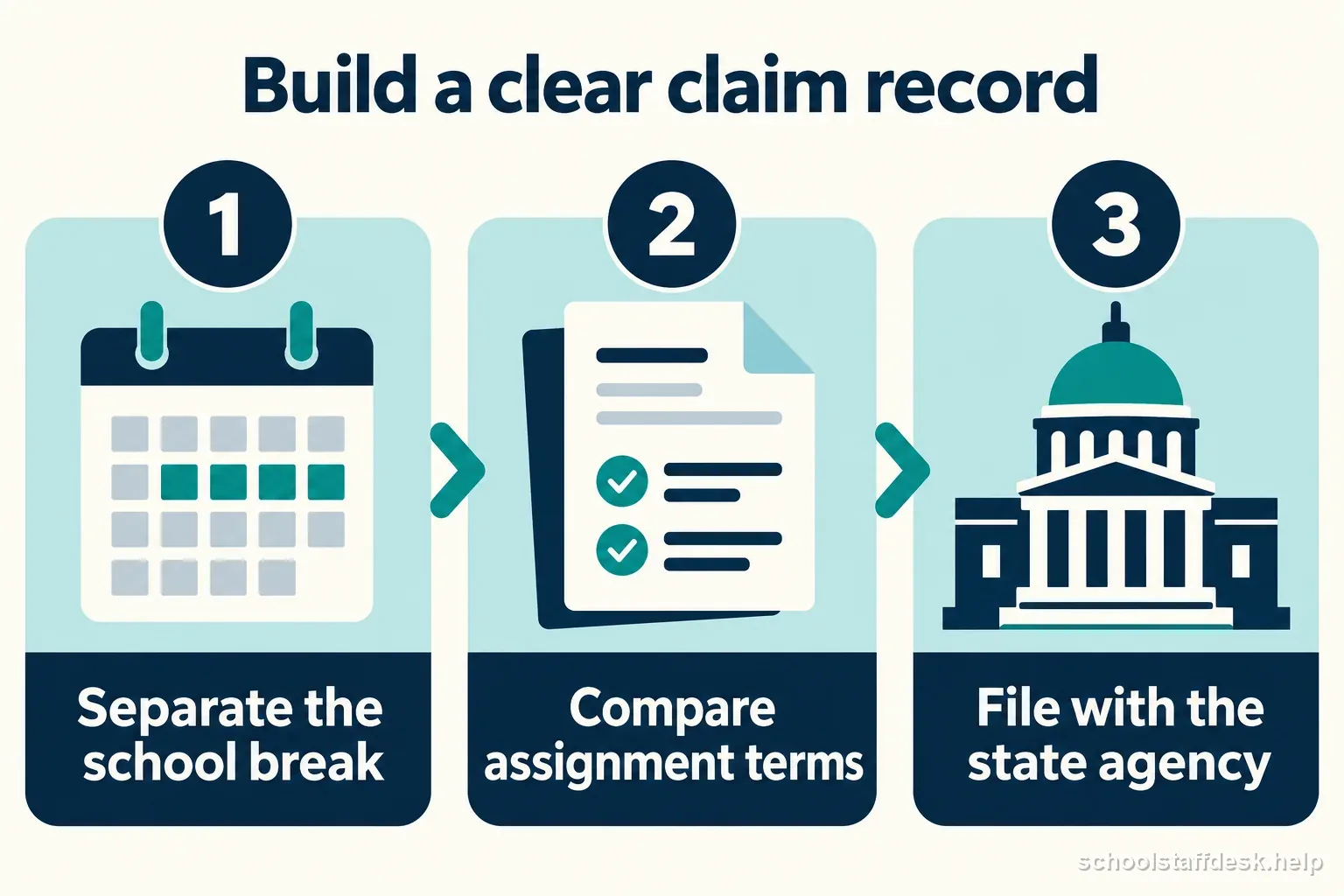
If you think you may qualify, follow your state agency’s filing instructions and report the facts accurately. A claim is a request for a determination, not a promise of payment. List school districts, staffing companies, and non-school employers separately; provide all wages and assignment dates the form asks for. If an employer gave you a reasonable-assurance letter, include it rather than omitting it or deciding for the agency what it means.
Keep evidence of your actual availability too. If you are willing to take work but cannot accept certain shifts because of schedule constraints, answer the state’s questions accurately. Before you decline an assignment, check how the state handles suitable-work offers. Write down the date, hours, rate, location, and reason for any offer you accept or turn down. A refusal can raise a separate eligibility issue.
Keep certifying on the schedule the state gives you, report earnings and refused offers as directed, and meet the state’s availability and work-search rules. Save weekly confirmations. If work is withdrawn or never becomes available, notify the agency and ask whether your claim or prior certifications should be reviewed. Some state laws provide retroactive payment in defined circumstances, but filing and certification deadlines still apply. For the broader return-offer test, see the guide to teacher unemployment between contract years. If you are weighing a multiweek classroom role, review the guide to the long-term substitute assignment before accepting its added duties.
If your position was eliminated, see the separate guide to teacher RIF and recall rights for selection, appeal, and recall questions.
If the agency denies benefits, read the determination and appeal instructions immediately. The state notice controls the route and deadline. Compare its stated facts with your records, including who made the offer, when it arrived, the duties and terms, whether conditions remained unresolved, and how often you worked for each employer. Ask the state agency or a qualified local advocate for help; a district coordinator cannot decide eligibility.


- File through the unemployment agency for the state where you are claiming.
- List every school, staffing, and non-school employer and report wages as instructed.
- Save each weekly certification and work-search confirmation.
- Tell the agency if a return offer changes or work is withdrawn.
- Read any denial notice and follow its appeal deadline.
The state agency decides eligibility; complete each required step while the claim is reviewed.
Sources used for this guide
- U.S. Department of Labor: UIPL No. 5-17: Contract and Reasonable Assurance
- New York Department of Labor: Unemployment Rules for Teachers and Other School Workers
- California EDD: School Employee Claims
- New Jersey Department of Labor: Information for Teachers and Other School Employees
Rules can change. Use these sources as a starting point and confirm any state, district, student-plan, employment, licensing, or retirement requirement with the agency or team that governs your situation.
Questions school staff ask about this situation
Can substitute teachers get unemployment benefits during summer break?
It depends on your state’s application of the federal and state rules and the facts about your next-term work. The agency may consider the communication, likelihood of work, capacity, and terms. File and follow your state’s instructions if you are unsure; a claim does not guarantee payment.
Does being on a district's substitute call list count as reasonable assurance?
A roster can be relevant, and some state guidance treats it as evidence of expected work; it does not settle every state’s test or every person’s facts. Check the claimant guidance for the state deciding your claim.
Should I bother filing for unemployment if I'm not sure I qualify?
If you believe you may qualify, follow your state agency’s filing instructions and report the facts accurately. The agency decides eligibility, and you must meet ongoing certification requirements to receive any benefits.
Does this rule apply to full-time teachers the same way?
The federal school-worker rule can apply to both professional and nonprofessional employees. A contract or return communication is evaluated under the applicable facts and state rules; a signed contract does not make every claim outcome automatic.