What national wage data actually shows
The U.S. Bureau of Labor Statistics (BLS) reports a $36,780 national median annual wage for teacher assistants in May 2025. The occupation includes many school paraprofessional and teacher-assistant jobs, but it is broader than one district job title. A median is the midpoint of reported wages: half of workers were above it and half below it. It is not a starting salary, an hourly rate, or a promise about your take-home pay.
BLS projects little or no overall employment change for teacher assistants from 2025 to 2035. That national outlook describes the occupation, not a forecast for openings in a particular district or for every related job title. For local comparisons, BLS state estimates and the district's own current schedule are more useful than treating the national median as an offer target.
Why pay varies so much by state and district
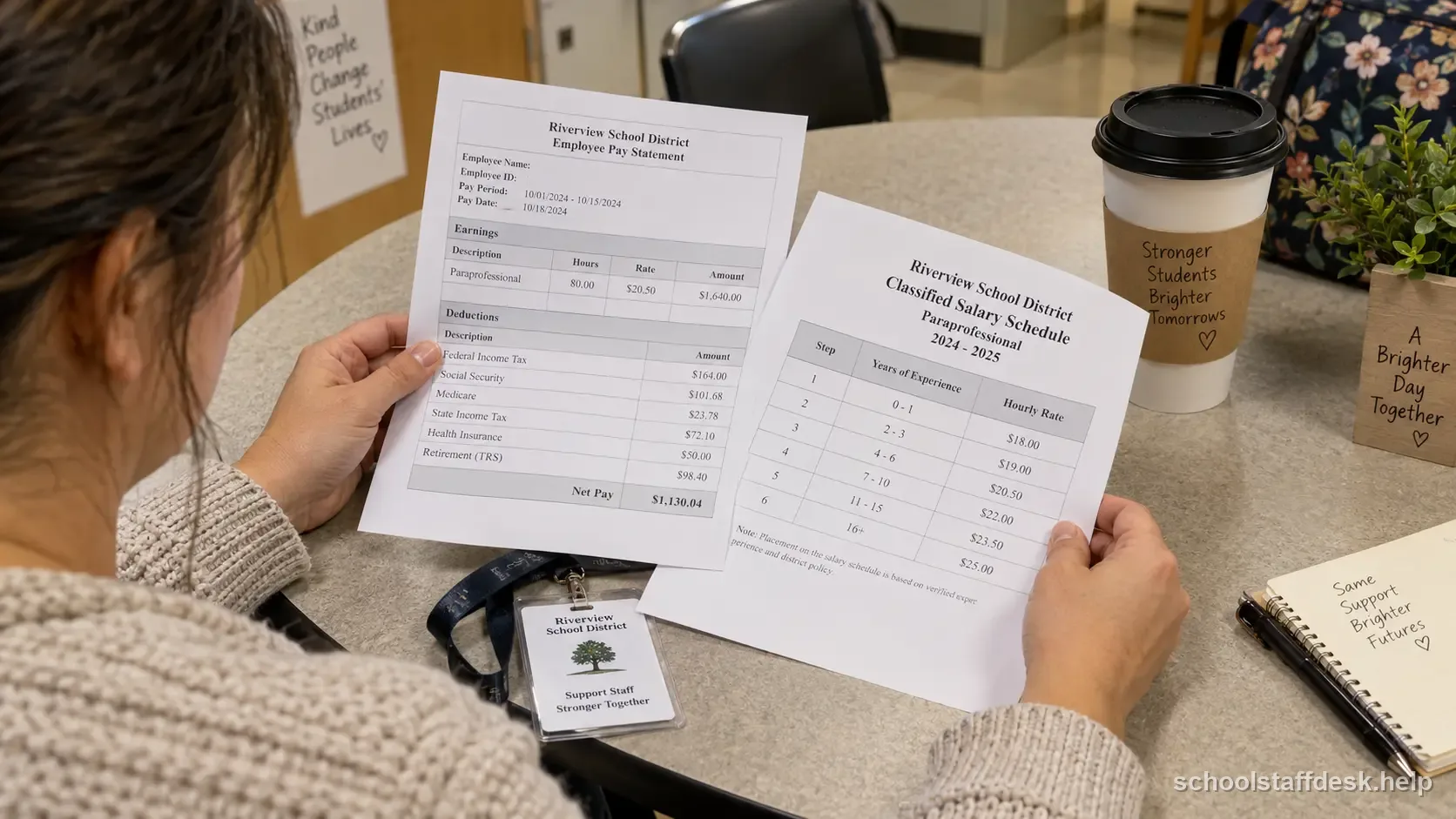
The job title alone does not determine the rate. Districts may use an hourly wage, a daily rate, or an annual salary; some schedules have steps for experience, education, credentials, or job classification, while others do not. A role funded through Title I is not automatically assigned a different pay step. Ask the employer which classification and schedule actually apply. Where a bargaining agreement covers the job, its wage and benefit provisions may also matter.
Do not assume every district is legally required to publish a paraprofessional schedule. Check the employer's HR or board documents, union agreement if applicable, and the written offer. BLS May 2025 state estimates can give a broader comparison, but state averages combine employers and do not replace a local offer.
The part-time hours pattern and why it exists
A short school-day schedule can mean lower annual earnings and can affect access to benefits, but a schedule by itself does not show why an employer set it. There is no single nationwide benefits threshold for every paraprofessional. For the Affordable Care Act employer shared-responsibility rules, an applicable large employer generally counts an employee as full time at an average of 30 hours of service per week or 130 per month; those rules apply to certain large employers and do not define eligibility for every district benefit or every employee. District plans, state law, collective bargaining agreements, and other rules may use different terms.
Ask HR for the written eligibility rule and whether it uses scheduled hours, hours worked, a look-back measurement period, or a position category. Ask when coverage begins, the employee premium, dependent costs, and whether hours vary during training or school breaks. Do not infer that a position is or is not benefit-eligible from a job-posting label like 'part time.'

| Offer detail | Hourly position | Annual or daily position |
|---|---|---|
| Starting figure | Hourly rate | Stated annual or daily rate |
| Work period | Rate × paid hours/day × paid days | Check days covered and any prorating |
| Breaks and closure days | Subtract unpaid time; confirm school closures | Confirm whether the stated salary covers breaks |
| Compare separately | Benefits cost, leave, summer work | Benefits cost, leave, summer work |
What to ask before accepting a paraprofessional position
Ask for the exact classification, pay rate, guaranteed weekly hours, number of paid workdays, and whether school closures or breaks are paid. If the job is hourly, confirm how required training, staff meetings, and work before or after student hours are recorded. Many paraprofessional roles are nonexempt under wage-and-hour law; if you are unsure how timekeeping or overtime works for your job, ask HR and consult the applicable state and federal rules.
For an annual estimate, multiply the stated hourly rate by the paid hours per day and paid workdays—not by 2,080 unless the position truly has that schedule. Then account separately for unpaid breaks, payroll spread across the year, benefits deductions, and any guaranteed summer work. Compare offers using the same assumptions so a higher hourly rate does not hide fewer paid hours or days.
Questions to ask before accepting a paraprofessional position
- What exact job classification and current salary schedule apply, and is the figure hourly, daily, or annual?
- How many paid hours per day and paid workdays are guaranteed, and how are training and meetings recorded?
- What written plan or agreement determines health coverage eligibility, start date, and employee premium?
- Are breaks, school closures, summer, or extended-year assignments paid or optional?
- How are experience, education, credentials, retirement, paid leave, and overtime handled for this position?
- Find the posted pay scheduleCompare the actual district rate, not a national figure.
- Check scheduled hoursCheck paid hours and days; do not infer benefit eligibility from the job label.
- Compare total compensationReview benefit premiums, paid time, and school-year gaps alongside wages.
- Ask how placement is setFind out which experience or education rules affect pay.
How to research actual pay before applying somewhere new
Search the district site for 'classified staff salary schedule,' 'paraprofessional agreement,' or the exact job title. Board agendas, HR pages, and union websites may have the document. If you cannot find it, request the applicable page from HR before accepting. Verify the schedule's effective school year and whether the posted range is hourly, annual, or prorated for a specific number of workdays.
Make a side-by-side offer comparison that uses the same period: estimated gross pay for the scheduled school year, paid holidays and breaks, employee health-premium cost, retirement contributions or vesting rules, paid leave, and any summer or extended-year work. A benefit with an employee premium is not the same as cash wages, so compare both the employer contribution and what you would pay.

How paraprofessional pay compares across different states
To compare a location with another state, use BLS May 2025 state estimates for teacher assistants as a consistent starting point, then check nearby districts' current schedules. BLS occupational estimates are not a complete census of every job title or benefit package, and the same title can cover different duties and contract lengths. Cost of living can add context, but it does not change the gross amount in a written offer.
If a pay or benefits question turns on a legal rule—such as minimum wage, overtime, paid leave, or health coverage—check the rule for your state and employer rather than relying on a general career page. For wage-and-hour concerns, keep your schedules and time records and contact the appropriate state labor agency or the U.S. Department of Labor for guidance.
When comparing two offers, convert each schedule into a realistic annual picture: paid days, daily hours, unpaid closures, required training, and whether summer work is available or merely possible. Then compare the written hourly rate or annual salary with the number of paid hours instead of dividing by a full-year schedule the job does not provide. Ask whether benefit eligibility is measured by contract hours, actual hours, or another rule, and when coverage begins if you qualify. The BLS national median is useful context, but a local bargaining agreement and the specific position posting determine the compensation you can actually accept.
Sources used for this guide
- U.S. Bureau of Labor Statistics — Teacher Assistants Occupational Outlook
- U.S. Bureau of Labor Statistics — May 2025 State Occupational Employment and Wage Estimates
- Internal Revenue Service — Employer Shared Responsibility Provisions
- U.S. Department of Labor — Fair Labor Standards Act
Rules can change. Use these sources as a starting point and confirm any state, district, student-plan, employment, licensing, or retirement requirement with the agency or team that governs your situation.
Questions school staff ask about this situation
What is the average pay for a paraprofessional?
BLS reports a $36,780 national median annual wage for teacher assistants in May 2025. Use it as context, then check the district's current schedule, paid hours, workdays, and exact classification; it is not a guaranteed paraprofessional offer.
Why are some paraprofessional positions part-time?
Schedules and benefit rules vary by employer. Ask HR for the written plan or agreement and how it measures eligibility. The ACA's 30-hour definition applies to employer shared-responsibility rules for applicable large employers, not as a universal benefits rule for every district.
Do all paraprofessional positions pay the same within a district?
Not necessarily. A district may use different classifications or experience steps, but Title I funding alone does not establish a higher or lower wage. Ask which written schedule applies to the job.
Is paraprofessional employment growing as a field?
BLS projects essentially flat growth ('little or no change') for Teacher Assistants nationally from 2025 to 2035, which is worth factoring into long-term career planning.