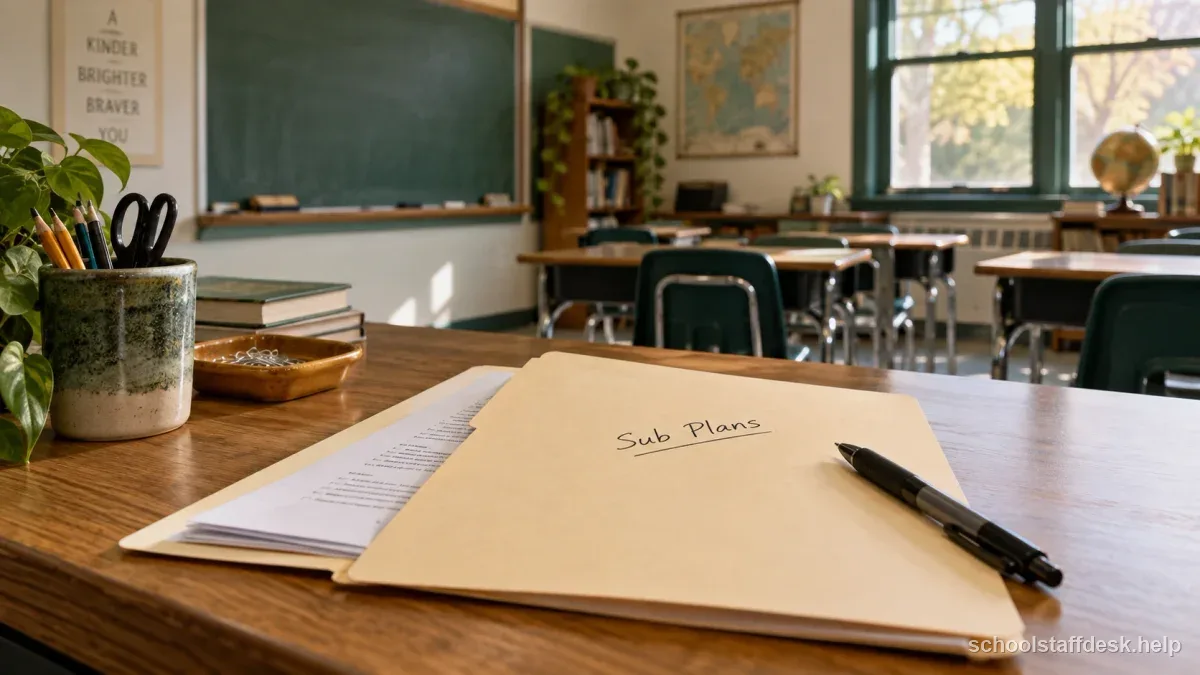
Assume the sub has your folder and nothing else
Write for an educator who may not know your room, routines, or current lesson. Put the schedule, lesson steps, routine information, and adult contacts in the district-approved plan system or designated folder. Include only student information the substitute needs for a legitimate educational purpose, and use approved secure channels for it; do not leave sensitive details in an open folder or ordinary email.
Make the plan skimmable: label periods and locations, number the steps, and separate what students do from what the substitute does. For websites and devices, give the district-approved guest-access steps or an offline alternative. Never write down or share your personal password.
The safety and roster information that cannot be missing
Lead with the daily schedule, room numbers, attendance process, and school emergency procedures for fire, lockdown, shelter, and early dismissal. Explain where the class goes and how to get help. If the substitute needs student-specific health, disability, or safety directions to carry out the assignment, make sure the relevant current instructions are available through the district-approved secure system and identify the responsible adult; do not put diagnoses or detailed records in an unsecured binder.
Include how attendance is submitted and by when, since an unrecorded absence is a safety gap, not just a paperwork one. If a student leaves your room on a schedule for a service or a check-in, list the time and the adult who comes for them so the sub is not surprised.
Lessons that hold up without you
Choose work students can begin from written directions and that fits the current unit. State the learning goal, what students should complete, and how the substitute can tell whether they finished. Leave a reasonable fallback task for a lesson that runs short, and label which work is essential versus optional; there is no universal extra-work ratio.
Spell out how materials are distributed, where completed work goes, and what the substitute should do if students need help or the task takes longer than planned. Include answer keys only where needed, and store them so students cannot access them. For digital work, provide guest access through district procedures or print an equivalent activity. Keep timing guidance flexible and describe what to skip if the class needs more time.
If work depends on a website, device, or password, leave exact access steps or a printed alternative so a substitute can keep the lesson moving.
Behavior and routines in writing
Explain entry, transitions, approved bathroom procedures, activity expectations, and dismissal. A substitute may ask a student where routine materials are, but should not assign students confidential, supervisory, or discipline responsibilities.
Describe the classroom support steps that fit your district's policy: calm, brief directions, an appropriate choice or redirection, and when to contact the office or designated support staff. Do not direct a substitute to use a physical intervention. Any emergency response must follow applicable law and district policy and may only be carried out by staff who are trained and authorized.
The who to call section
List the neighboring teacher or team, front office, nurse, and administrator using the contact method the district approves. Confirm the named colleague has agreed to be the substitute's point of contact.
State when to use each contact: the office for schedule or dismissal changes, the nurse for health questions, and the designated administrator or response team for a safety concern. Do not ask substitutes to make medical or disciplinary decisions outside their role.
Keep an emergency set that is always current
Separate from daily plans, maintain a generic emergency folder with current schedules, attendance directions, safety procedures, contacts, and device-free activities aligned to the class's current level. Keep sensitive student-specific information in the approved secure system. Refresh the folder whenever schedules, rosters, or procedures change and review the activities as the class advances.
Tell the office and your go-to colleague where the folder lives, physically and digitally. A same-day absence is exactly when a good folder earns its keep, and a stale one causes its own problems.
The always-ready emergency substitute folder
- Current class rosters, seating charts, and the daily schedule with room numbers.
- Fire, lockdown, shelter, and early-dismissal procedures, including where the class goes and where the emergency roster is.
- A contact block: neighboring teacher, grade-level lead, office, nurse, administrator, and a named go-to colleague.
- The district-approved secure route to any student-specific health or support directions the substitute needs; never include passwords.
- A flexible set of on-grade, no-device activities with clear instructions and needed answer keys.
- A short feedback half-sheet for the substitute to complete before leaving.
What to have the sub leave for you
Ask for a short written note at the end of the day: which classes completed which work, what did not get done, any student who was sent out or needed the office, technology or supply problems, and anything a student reported that you should follow up on. A two-minute note prevents a Monday of reconstruction.
Leave a blank feedback half-sheet with prompts so the sub does not have to invent the format. When you return, read it before you re-teach anything, adjust the next lesson to where the class actually is, and thank a sub who left the room in good shape so they will accept your room again.
A planned absence and a sudden one need different documents
When you know in advance, you can tailor the day: write the actual lesson, tell a neighboring teacher you will be out, and leave materials sorted and labeled. When you are out with no warning, none of that happens, which is why the generic emergency folder has to stand on its own with current rosters, safety procedures, contacts, and low-prep activities that fit roughly where any class would be.
A multi-day planned absence is its own case. Leave a day-by-day packet rather than one lesson stretched thin, name a single colleague as the point of contact so the substitute is not guessing who to ask on day three, and include grading instructions so work does not pile up ungraded until you return. State which assignments you want collected and set aside, and which can be checked for completion and handed back, so the substitute is not making that call for you.
| Planned absence | Sudden absence | |
|---|---|---|
| Lesson materials | Tailor day-by-day lessons and sort materials | Use a current generic set of low-prep activities |
| Communication | Tell a neighbor and name one contact for a multi-day absence | Make sure the office and go-to colleague know where the folder is |
| Student work | Mark what to collect, grade, or set aside | Include clear instructions and an offline alternative |
| Folder readiness | Supplement the always-ready materials as needed | Depend on current rosters, safety procedures, and contacts already stored |
Sources used for this guide
- U.S. Department of Education — Readiness and Emergency Management for Schools (REMS) Technical Assistance Center
- U.S. Department of Education — Individuals with Disabilities Education Act (IDEA)
- U.S. Department of Education — FERPA
- U.S. Bureau of Labor Statistics — Occupational Outlook Handbook: Substitute Teachers, Short-Term
Rules can change. Use these sources as a starting point and confirm any state, district, student-plan, employment, licensing, or retirement requirement with the agency or team that governs your situation.
Questions school staff ask about this situation
How much lesson material should I leave for one day?
Plan the essential lesson and one flexible fallback or early-finisher task. Mark what can be skipped if the class needs more time; there is no universal extra-work ratio.
Should substitutes handle serious behavior incidents themselves?
Give the substitute the district-approved classroom support steps and contact path. Any physical intervention must follow applicable law and district policy and may only be carried out by trained, authorized staff.
What has to be in the plan no matter what?
The schedule, attendance directions, emergency procedures, adult contacts, lesson instructions, and a secure route to any student-specific health or support direction the substitute needs. Keep sensitive records out of an open folder.
Why keep a separate emergency folder?
Same-day absences leave no time to build plans. A generic folder with current rosters, safety procedures, contacts, and low-prep activities means a stranger can still run a safe day. Refresh it whenever rosters or schedules change.