Learn your building's vocabulary, because emergency words are local
Schools may use terms such as lockdown, secure, hold, evacuation, shelter, or other district-specific language. The definitions are not identical everywhere. Read the Emergency Operations Plan or staff quick guide and learn what each announcement requires you to do. Do not import a procedure from your previous district simply because the same word sounds familiar.
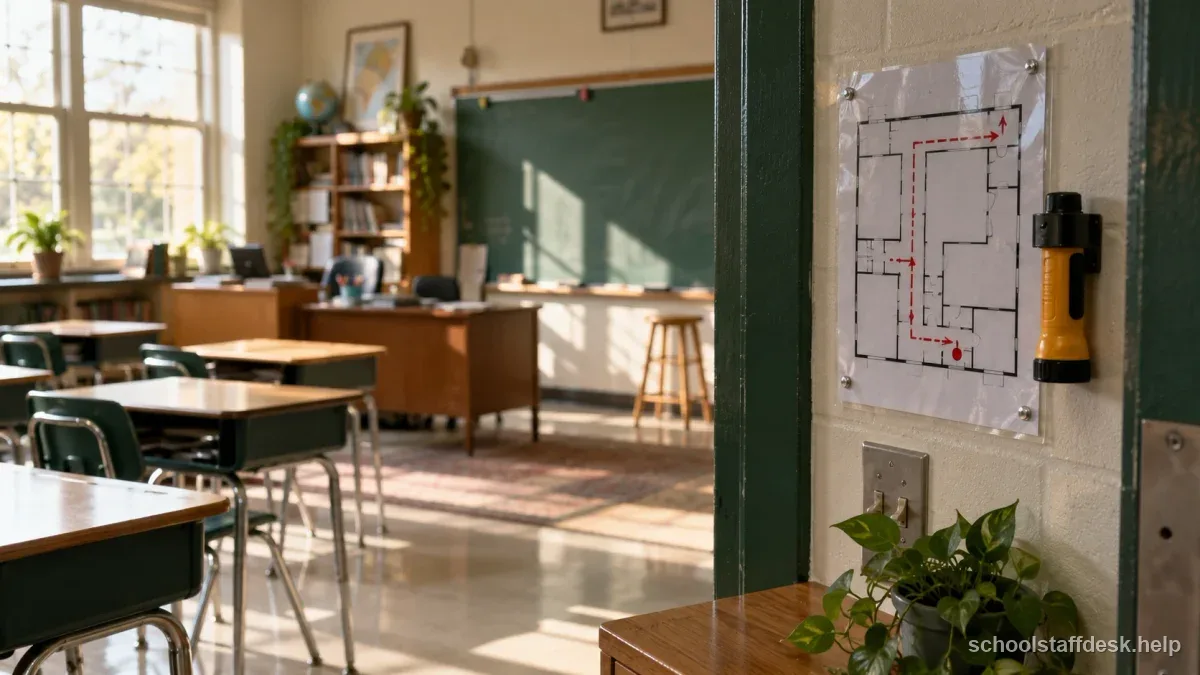
Ask where the plan lives when the network is down. Staff should be able to act from a printed quick reference, posted card, or trained procedure rather than needing to search a website during an incident. The federal reference points are the Guide for Developing High-Quality School Emergency Operations Plans and the Readiness and Emergency Management for Schools (REMS) Technical Assistance Center, which organize planning around five mission areas: prevention, protection, mitigation, response, and recovery.
Keep the roster and essential go-items in a place a substitute can find
Know how you account for students during evacuation or relocation and where the roster, emergency card, classroom key, and go-bag are kept. If the district uses a digital attendance system during emergencies, learn the backup when the system or power fails.
Do not pack a personal survival kit full of medication or confidential documents outside the district process. Student-specific emergency supplies belong in the locations and custody defined by the school’s health and safety plans.
Plan for students who cannot simply follow the crowd
Emergency planning must include students who need mobility assistance, communication supports, sensory accommodations, adult supervision, medical equipment, medication, or additional processing time. Know who assists, which accessible route is used, and what happens if the usual staff member is absent. A drill that leaves one student behind is revealing a plan failure, not a student failure.
Coordinate these needs with the student’s applicable support plan and the school emergency team. Avoid creating an informal procedure known only to one para or teacher. Document accessible routes, trained helpers, backup coverage, equipment, and communication needs in the school’s emergency plan and the student-specific support documents the district uses for those details; IDEA and Section 504 require appropriate access and supports but do not prescribe one universal emergency-plan form.
Use drills to test access needs, roster control, and handoff—not just compliance
During an evacuation, can the adult responsible for the class account for students without relying on memory? During a lockdown or shelter action, can a substitute find the instructions? Can a student who uses mobility equipment, communication support, medication, sensory support, or one-to-one assistance follow the route and remain supervised? A drill that exposes a barrier is valuable only if someone records the barrier and the Emergency Operations Plan or student-specific support is adjusted.
After a drill, route each barrier to the safety team with the location, affected role or student need, and the training or plan change that may resolve it. Generic internet advice can help staff prepare questions, but it does not override the building’s command structure during an incident.
Reunification deserves the same attention as the initial response. Know where students are accounted for, who may release them, how authorized pickup is verified, and what staff do with a student whose authorized adult has not arrived. The emergency does not end when everyone reaches the parking lot.
Emergency-role drill audit
- Learn the difference between your site's lockdown, evacuation, shelter, secure, hold, or other emergency actions because terminology is local.
- Keep the roster and go-bag where a substitute or para can find them without searching.
- Plan for students who need mobility, communication, sensory, medication, or adult support during an emergency.
- Practice accounting for students after movement without relying only on memory.
- Know the reunification location and chain of command before an incident occurs.
Evacuation means movement; lockdown means a different safety posture
An evacuation moves people away from a hazard or building to a designated location. A lockdown generally involves securing people in response to a threat, while shelter procedures address specific hazards such as severe weather or environmental conditions. Your district may define additional actions such as secure or hold. Follow the local command, not a generic internet checklist.
During any action, supervise students, follow communication restrictions, and avoid posting live information or photos to social media. Emergency communication belongs through the school’s authorized system.
| Evacuation | Lockdown | Shelter | |
|---|---|---|---|
| General action | Move people away from a hazard or building | Secure people in response to a threat | Respond to a specific hazard |
| Local follow-through | Go to the designated location and account for students | Use the local secured-room procedure | Follow the site's shelter instructions |
| Local command | Use the building's assigned destination and roster | Follow the building's secured-room command | Follow the building's hazard-specific direction |
Plan reunification before an incident
Know where students may be reunified with families after a major event, how student release is documented, and which staff verify authorized pickup. The same dismissal safeguards still matter under stress; do not release a student based only on an adult’s claim of family relationship.
Your role may be student supervision rather than family check-out. Stay in the assigned function so the overall system can maintain accountability.
Use reunification practice to expose missing handoffs
After the drill, confirm that every student was accounted for and that assigned and backup adults could locate the roster, route, and authorized need-to-know support information. Send unresolved gaps to the emergency-planning team so the plan and substitute briefing can be updated.
Treat drills as tests of the plan
After a drill, note barriers: a door that would not lock, a roster that was outdated, a student who could not use the route, a radio dead zone, a substitute who did not know the procedure, or confusion over who brought medication. Report those problems through the safety team instead of congratulating the class only for being quiet. Practical drill barriers worth logging by name: a door that will not lock from inside, a class roster that predates a transfer, an evacuation route with a curb or stair a wheelchair cannot clear, a stairwell radio dead zone, and a substitute who was never handed the quick-reference card.
The U.S. Department of Education’s emergency-planning guidance emphasizes planning, training, exercises, and continuous improvement. A drill has value when it changes the plan or training where a weakness appears.
- During the drillNotice barriers such as an outdated roster, inaccessible route, or missing substitute instructions.
- After movementRecord who was accounted for and any handoff or communication gap.
- Through the safety teamReport the barrier so training or the emergency plan can be adjusted.
Sources used for this guide
- U.S. Department of Education — Emergency Planning
- CISA — K-12 School Security Guide, 2nd Edition
- U.S. Department of Education — Guide for Developing High-Quality School Emergency Operations Plans (REMS TA Center)
- New York State Education Department — Emergency Evacuation of Non-Ambulatory Disabled Individuals
Rules can change. Use these sources as a starting point and confirm any state, district, student-plan, employment, licensing, or retirement requirement with the agency or team that governs your situation.
Questions school staff ask about this situation
Are lockdown procedures the same in every school district?
No. Emergency terminology and actions vary. Learn the exact definitions and procedures in your school’s Emergency Operations Plan and training.
What should be in a classroom go-bag?
Use the district’s defined contents, which may include roster or accountability materials and basic emergency items. Student medications and confidential records should follow the school’s health and custody procedures.
How should students with mobility or medical needs be included?
The school emergency plan should identify accessible routes, trained staff, equipment, communication supports, and backup personnel. These needs should be tested during drills.
What should staff do after a drill exposes a problem?
Report the barrier through the school safety process and update training or the plan as appropriate. Drills are meant to reveal weaknesses before a real emergency.