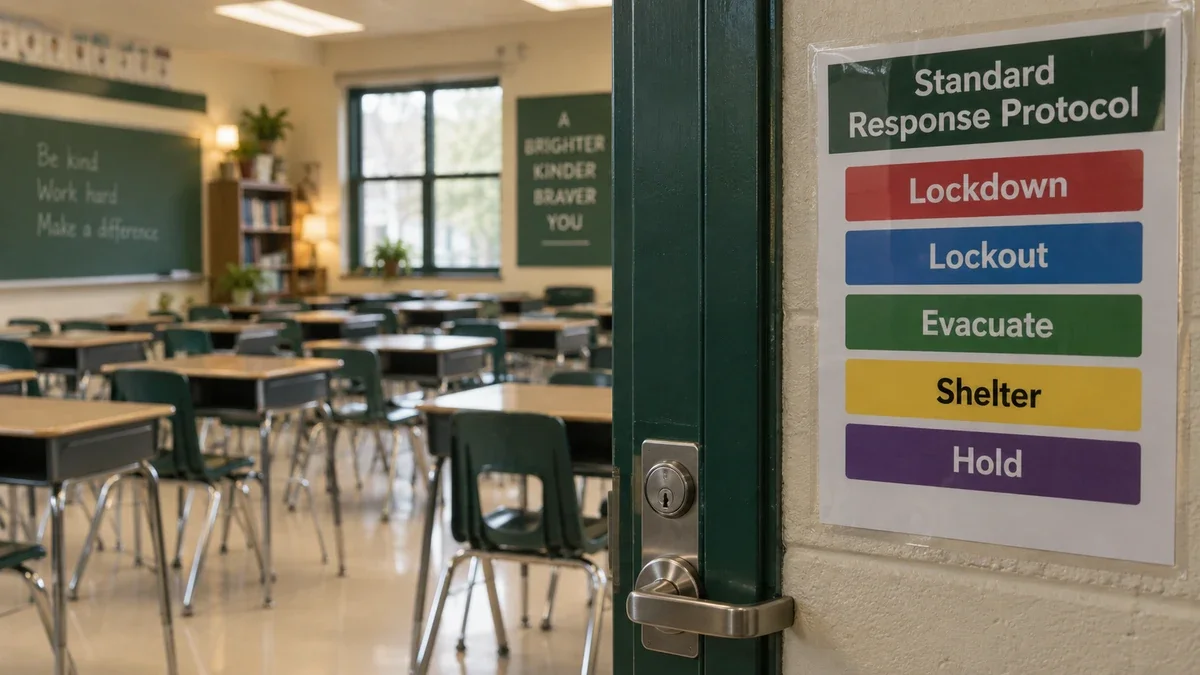
ALICE: a menu of options, not a single instruction
ALICE stands for Alert, Lockdown, Inform, Counter, and Evacuate. The model exists because a strict lockdown-only response assumes every threat is identical and best handled by locking a door and staying silent — which is not true for every scenario. ALICE trains staff and students to assess the specific situation and select the best option: locking down and barricading if the threat is not in the immediate area, evacuating if a safe path exists, or as a last resort, disrupting an attacker's ability to cause harm when there is no other option.
Critically, staff — not students — are trained to make the split-second call about which option applies. Under the teacher or staff member's direction, the room listens for information about where the threat actually is, moves to a secure area or evacuates if a path is clear, and uses trained disruption tactics only as a genuine last resort when neither locking down nor evacuating is possible.
Standard Response Protocol: a shared vocabulary across a building
Standard Response Protocol (SRP) is a related but distinct framework many districts layer on top of or instead of ALICE, built around a small set of consistent commands — Lockdown, Lockout, Evacuate, Shelter, and Hold — so that every staff member, substitute, and student understands the same instruction the same way regardless of which classroom or grade level they're in. At the start of each school year, staff review these protocols with students, with age-appropriate lessons built for elementary, middle, and high school audiences.
What staff are actually responsible for during a real drill
Know your room's specific hardware: does the door lock from the inside without a key, or does it require a key you need on your person at all times, not left in a desk drawer. Know your room's realistic evacuation path and secondary path if the primary is blocked. Know where students who are out of the room (bathroom, nurse, another class) are expected to go if a lockdown begins while they're away from your classroom — this is one of the most commonly overlooked gaps in a real event.
During the drill itself, your job is to move calmly, account for every student by name against your roster, communicate only the confirmed necessary information rather than speculation, and know how you're expected to signal 'all clear' or continued danger to whoever is checking your room. Debrief honestly afterward — a drill that reveals your classroom's door doesn't actually lock, or that you couldn't reach the light switch without crossing sightlines from the door window, is far more useful than a drill that goes smoothly because everyone already knew what to expect.
How often your state actually requires this
Drill frequency requirements vary meaningfully by state — Michigan, for example, requires lockdown drills three times per school year, and many other states set their own minimum through state law or state board of education policy rather than leaving it purely to district discretion. Check your own state's specific requirement rather than assuming your district's schedule matches a number you've heard applied elsewhere; some states also mandate a fire-drill-to-lockdown-drill ratio or require law enforcement participation in at least one annual drill.
Before the first drill of the year, confirm you know
- How your specific classroom door locks, and whether you need a key on your person at all times
- Your room's primary and secondary evacuation paths
- Where students out of the room during a lockdown are expected to go
- How you're expected to account for and report your roster status
- The specific command vocabulary (SRP terms or ALICE steps) your district actually uses, since it varies by district
Debriefing after a real event, not just a drill
If your school ever experiences an actual lockdown — not a scheduled drill — the post-event debrief matters as much as the response itself. Staff should be given a real opportunity to report what worked, what didn't, and where the plan assumed conditions that weren't actually true (a door that didn't lock as expected, a communication gap, confusion about which command was given). Districts that treat every real lockdown as a closed matter once the immediate danger passes miss the chance to fix the exact gaps a drill is designed to catch before they matter again.
Communicating with families during and after a drill
Districts generally have a communication plan for notifying families after a real lockdown event, and staff should know their own role in that plan — typically, individual staff are not the ones fielding parent calls or posting on social media during or immediately after an event; that communication runs through the front office or district communications staff specifically to avoid conflicting or premature information reaching families. Knowing this in advance prevents a well-meaning staff member from inadvertently creating confusion by communicating outside the district's established channel during a live event.
New staff and mid-year hires need this training on their own timeline
A teacher or aide hired in November has missed the school year's opening safety training entirely unless the district has a specific onboarding process for it. Don't assume a mid-year hire absorbs this information by osmosis from colleagues — confirm directly with your building administrator on your first week whether dedicated safety-protocol training has been scheduled for you, and if not, ask for it explicitly rather than waiting for the next scheduled all-staff drill to learn your building's specific procedures.
Sources used for this guide
- Texas School Safety Center — K-12 Standard Response Protocol Toolkit
- Navigate360 — The Ultimate Guide to ALICE Training for Schools
- Fairfax County Public Schools — FAQs About Lockdown Drills
Rules can change. Use these sources as a starting point and confirm any state, district, student-plan, employment, licensing, or retirement requirement with the agency or team that governs your situation.
Questions school staff ask about this situation
Are students expected to make the same tactical decisions as staff during ALICE training?
No. Age-appropriate versions of ALICE are taught to students, but staff are the ones trained and expected to make the real-time decision about which response option applies in an actual event, particularly for younger students.
Does ALICE replace the traditional lockdown-only approach entirely?
Not necessarily — many districts use ALICE alongside Standard Response Protocol's lockdown command as one of several options, rather than eliminating lockdown as a response. The point of ALICE is adding options, not removing the traditional response when it's genuinely the right call.
What should a substitute teacher do if they don't know the building's specific protocol?
Ask at check-in, every time, even if you've subbed at the same school before — protocols and room hardware can change between visits. A sub who doesn't know the classroom's specific door lock or evacuation path is a real gap a lockdown drill is meant to catch before it matters.
Should classroom doors be left unlocked during normal instruction for faster ALICE response?
Most current guidance actually recommends keeping classroom doors locked during regular instruction, not just during a drill or event, since a door that's already locked removes a critical step during an actual emergency. Check your specific district's policy, since practices here have shifted over time as ALICE and similar frameworks have been adopted.