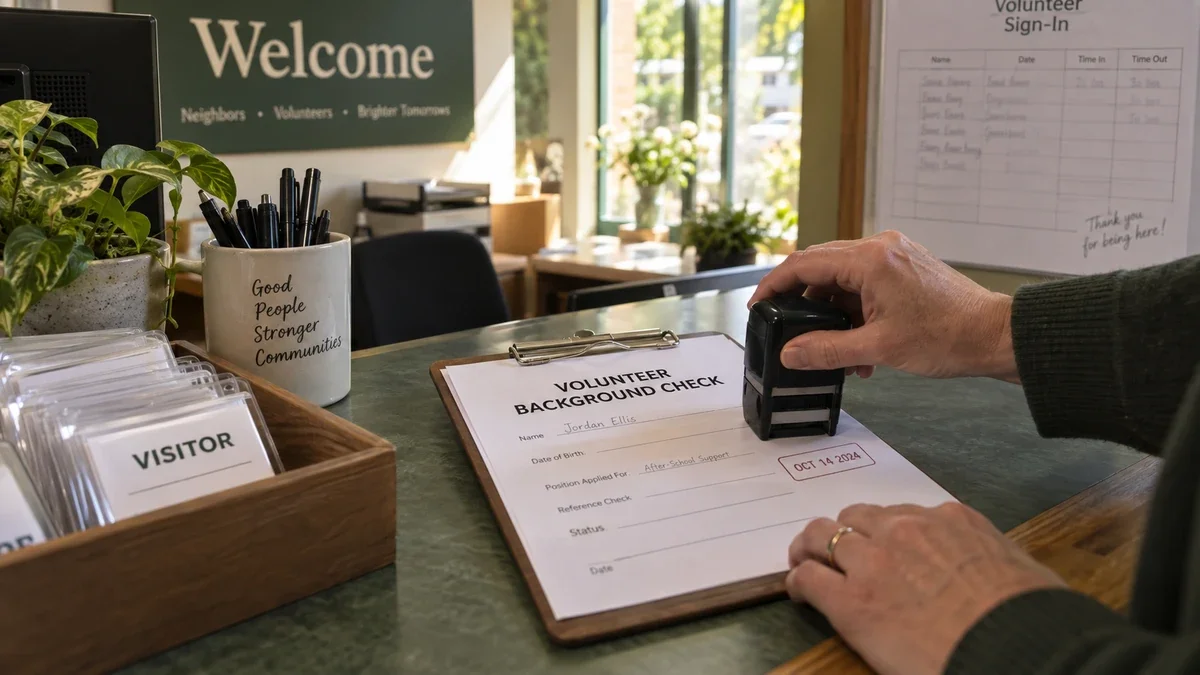
There is no single federal requirement
There is no single federal law mandating background checks for school volunteers. What applies to your school comes from a combination of state law, your district's own policy, and your organization's own risk tolerance — which means the honest answer to "what's required" starts with checking your specific state and district policy, not assuming a national standard exists.
How dramatically this varies by state
Florida requires all school volunteers to complete a Level 2 background check — fingerprinting plus a comprehensive state and federal criminal records screening — before working with students, a requirement that took effect in 2025. Pennsylvania requires any volunteer with direct student contact to complete a state police criminal history check, a state child abuse history clearance, and an FBI fingerprint check, even for a parent volunteering as an occasional classroom reader. California requires schools to check the Megan's Law sex offender registry specifically for volunteers, which is a narrower requirement than Florida's or Pennsylvania's full fingerprint-based screening.
This spread matters practically: a screening process copied from a district in a neighboring state, or from a national volunteer-coordination template, may be significantly weaker than what your own state actually requires — or may impose requirements your state doesn't mandate, creating unnecessary friction for volunteers. Check your own state department of education's specific volunteer screening guidance directly.
Why treating volunteers casually is a real institutional risk
A school volunteer who harms a student creates essentially the same legal, institutional, and human consequences as an employee who does, and courts have applied negligent hiring and negligent supervision principles to schools and districts that placed volunteers in student-facing roles without adequate screening. Staff who coordinate volunteers sometimes unconsciously treat the process as a formality because volunteers are unpaid and often already known to the school community — a parent, a grandparent, a familiar face. That familiarity is exactly why the screening step gets skipped, and exactly why it shouldn't be.
Applying the same screening standard to unlicensed volunteers that applies to paid staff and other adults with comparable access to children is the baseline most legal guidance in this area converges on, even in states without an explicit statutory volunteer-screening mandate.
What staff coordinating volunteers should actually verify
Confirm your state's specific requirement (fingerprint-based check, registry check only, or district-set policy in the absence of a state mandate), confirm your district's own policy doesn't exceed or fall short of that state requirement in a way that creates a compliance gap, and confirm the screening is actually completed and on file before a volunteer has unsupervised or direct access to students — not retroactively after they've already started helping out because they were needed urgently for an event.
Before a volunteer works with students, confirm
- You know your specific state's volunteer screening requirement, not a general assumption
- Your district's own policy has been checked against that state requirement
- The required check is completed and on file before any unsupervised or direct student contact begins
- There's a clear record of when the check was completed and by whom it was reviewed
How often a completed screening needs to be renewed
A background check is not necessarily a one-time event — many states and districts require renewal on a set cycle (commonly every few years) rather than treating an initial clearance as good indefinitely. A long-tenured, well-known volunteer whose original screening happened many years ago may actually be out of compliance with a current renewal requirement, which is worth auditing periodically rather than assuming familiarity substitutes for an up-to-date record.
What to do if a background check reveals a concern
A background check that surfaces a criminal history finding doesn't automatically bar someone from volunteering in every state or district — policies vary on which offenses are automatically disqualifying versus subject to individualized review, and how much time must have passed. Staff coordinating volunteers should know their district's specific process for handling a flagged result, including who makes the final decision, rather than making an ad hoc call themselves or assuming any finding at all is automatically disqualifying.
Volunteer coordinators should keep records separate from personnel files
Volunteer screening records generally should not be filed together with paid staff personnel records, since volunteers are not employees and mixing the two record sets can create confusion about who has access rights to review them and under what retention schedule. Keep a dedicated volunteer file system — even a simple spreadsheet with check completion dates and renewal due dates — that someone other than the person who ran the check can audit periodically.
What families should reasonably expect to see documented
A parent asking "has this volunteer been screened" is a reasonable question, and schools generally should be able to confirm that a completed, current screening is on file without necessarily disclosing the specific contents of the background check itself, which is typically confidential. Staff coordinating volunteers should know how to answer this kind of parent question accurately — confirming a policy was followed — without either oversharing protected information or deflecting a legitimate safety question entirely.
Volunteer screening and PTA-run or booster-club events
Events run partly by a PTA or booster club sometimes involve volunteers recruited outside the school's normal channel entirely, which can create a gap where no one is confident whose responsibility screening actually was. If your school allows PTA- or booster-club-recruited volunteers into student-facing roles — concession stands with student access, event supervision, chaperoning — clarify explicitly with those organizations whether the school's screening requirement applies to their recruits the same way it applies to volunteers recruited directly by staff, rather than assuming a parent-run organization's own informal vetting satisfies the school's actual legal obligation.
Sources used for this guide
- gcheck — School Volunteer Background Check Requirements: A Guide for K-12 Administrators
- HolyJot — School Volunteer Background Checks: Requirements & Best Practices 2026
Rules can change. Use these sources as a starting point and confirm any state, district, student-plan, employment, licensing, or retirement requirement with the agency or team that governs your situation.
Questions school staff ask about this situation
Does a one-time field trip chaperone need the same screening as a regular weekly volunteer?
This depends entirely on your state and district policy — some states and districts do distinguish between occasional supervised chaperones and volunteers with regular, less-supervised access to students, while others apply the same standard to both. Check your specific policy rather than assuming a lighter standard applies to one-time volunteers.
Who is legally responsible if an improperly screened volunteer harms a student?
Liability analysis in these cases typically looks at the school or district's own negligent hiring and supervision practices, meaning the institution — not just the individual volunteer — can bear significant legal responsibility for an inadequate screening process.
Can a district require stricter volunteer screening than the state mandates?
Yes. State law generally sets a floor, not a ceiling — a district can adopt a stricter volunteer screening policy than its state requires, and many do, particularly for volunteers who will have regular or unsupervised contact with students.
Do coaches and athletic volunteers fall under the same screening rules as classroom volunteers?
In most states and districts, yes — athletic volunteers and assistant coaches typically fall under the same or an equally strict screening requirement as classroom volunteers, given their often unsupervised access to students during practices, travel, and locker room supervision.