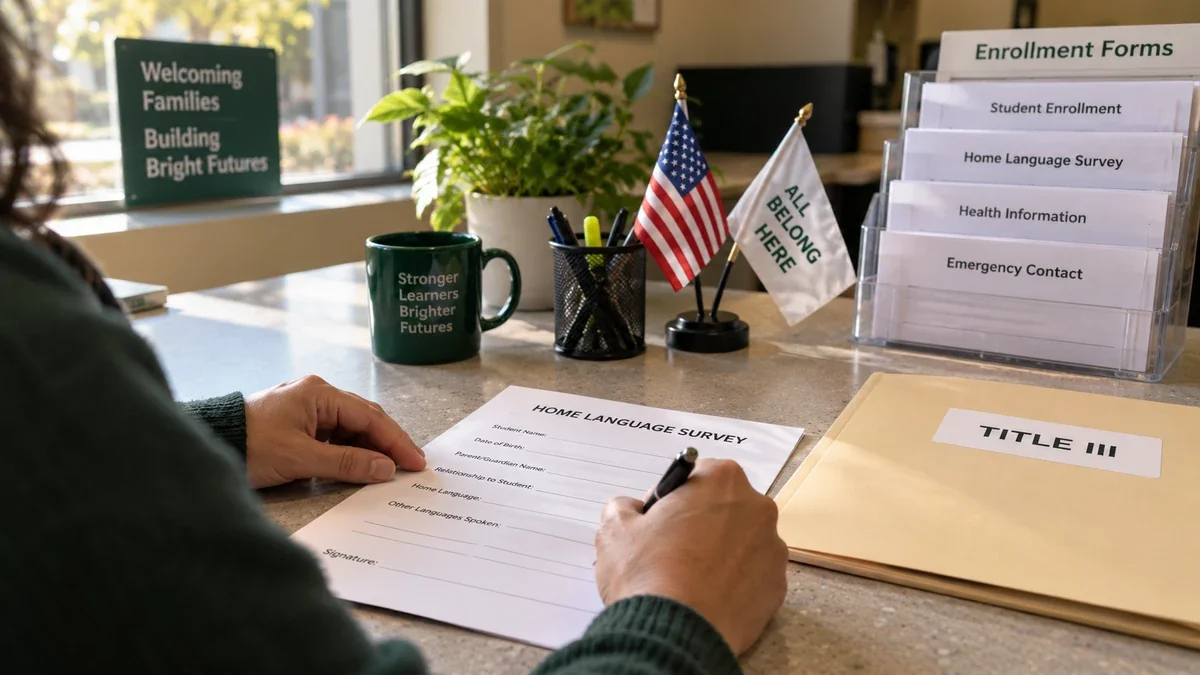
What Title III actually is
Title III, Part A of the Elementary and Secondary Education Act, as reauthorized under the Every Student Succeeds Act (ESSA), funds programs to help English learners (ELs) attain English proficiency while meeting the same state academic standards as their peers. It is not a special-education program and EL status is not a disability category — a student can be an English learner, have a disability, both, or neither, and each status is identified and served through its own separate process.
Title III funds flow to states, then to local school districts, and are meant to support additional bilingual staff, supplemental instructional materials, language-acquisition software, and professional development for teachers who work with EL students — not to replace a district's core instructional obligations to those students.
What the law actually requires of identification and services
Districts are required to identify potential EL students through a home language survey at enrollment, confirm status with a valid English proficiency assessment, place identified students in an appropriate language instruction program, and monitor progress toward proficiency using state-approved assessments, typically administered annually. Staff who handle new-student enrollment should know whether their school's process actually includes this home language survey every time — a missed survey at enrollment can delay a student's legally required access to services.
ESSA also strengthened Title III's requirement that funded activities be effective, and specifically requires parent, family, and community engagement activities as part of a district's Title III program — not just classroom-based language instruction. This means EL obligations legally extend into how the district communicates with families, which is exactly where front-office and general classroom staff most often intersect with these requirements even without direct EL-instruction duties.
What this looks like for staff who aren't EL specialists
A front-office staff member enrolling a new family should know where the home language survey lives in the enrollment packet and should not skip it because a family appears to speak English comfortably in a brief conversation — the survey and formal assessment exist precisely because a brief conversational impression is not a reliable proficiency measure. A general education teacher with an EL student in a mainstream classroom should know whether that student has an active individual language plan and what accommodations it specifies, the same way they would check an IEP or 504 plan for services affecting instruction.
Paraprofessionals and support staff who interpret informally for families, even occasionally, should understand that formal, qualified interpretation is what's actually required for meaningful family communication under federal civil rights guidance — a bilingual staff member helping out informally in the hallway is not a substitute for the district's actual interpretation and translation obligations for important communications like discipline meetings, IEP meetings, or enrollment paperwork.
What any staff member should be able to answer
- Does our enrollment process include a home language survey for every new family, every time?
- Where can I check whether a student in my class has an active EL identification and language plan?
- Who is our school's designated qualified interpreter contact for family communications that matter legally (discipline, IEP, enrollment)?
- How does our school monitor and report EL students' annual English proficiency assessment results?
Immigrant student protections run alongside, not instead of, EL services
Title III also funds services for immigrant children and youth specifically, which is a related but distinct category from EL status — an immigrant student may or may not also be classified as an English learner, and the specific supports and funding streams differ. Staff working with newly arrived immigrant families should understand that enrollment cannot be conditioned on immigration status documentation, a protection that predates and operates independently of Title III itself, and that federal guidance in this area is specifically aimed at removing enrollment barriers rather than adding them.
How EL status connects to graduation and grade-level testing requirements
EL students are generally still required to participate in the same state academic assessments as their peers, though federal and state guidance provide specific accommodations and, in some cases, temporary exemptions from the English language arts portion during a student's first year in a U.S. school. Staff advising EL students and families about graduation requirements or standardized testing schedules should confirm the current accommodation and exemption rules with the district's EL coordinator rather than applying a general assumption, since these rules have been adjusted over successive ESSA guidance updates.
Long-term English learners are a distinct concern worth knowing about
Some states specifically track and report on "long-term English learners" — students who have been receiving EL services for an extended period, commonly five years or more, without reaching proficiency. This population is a specific policy and instructional concern distinct from newly arrived EL students, since it often signals a need for a different instructional approach rather than simply more time in the same program. Staff working with a student who has been an EL for many years without progress should flag this to the EL coordinator as a distinct concern rather than assuming continued standard services will eventually resolve it.
Dual-language and bilingual programs are a district choice, not a federal requirement
Title III does not require districts to offer a specific instructional model — dual-language immersion, transitional bilingual education, structured English immersion, and pull-out ESL support are all approaches a district may choose, and the specific model available to a given EL student often depends on district size, the concentration of a particular home language, and available bilingual staff. Staff advising families should be accurate about which model their specific school actually offers rather than describing options available at a different district or a different school within the same district.
Sources used for this guide
- U.S. Department of Education — Non-Regulatory Guidance: English Learners and Title III of ESSA
- NCELA — Title III Grants FAQ
Rules can change. Use these sources as a starting point and confirm any state, district, student-plan, employment, licensing, or retirement requirement with the agency or team that governs your situation.
Questions school staff ask about this situation
Is being an English learner the same as having a learning disability?
No. EL status reflects a student's English language proficiency, not a disability. A student can be an English learner without any disability, have a disability without being an English learner, or both — and correctly distinguishing between the two affects which services and legal protections apply.
Can a school decline to identify a student as an English learner if the family doesn't request it?
No. Identification is required to be based on the home language survey and a valid proficiency assessment, not on whether a family specifically requests services. Districts have an affirmative obligation to identify potential EL students at enrollment.
Do private or informal interpretation arrangements satisfy a district's legal obligations?
Generally no for communications that carry legal or educational significance — discipline hearings, IEP meetings, enrollment, and similar interactions typically require qualified interpretation the district is responsible for arranging, not an ad hoc bilingual staff member or student sibling interpreting informally.
How is a student's home language survey information used beyond initial identification?
Beyond triggering the initial English proficiency assessment, the home language information typically informs which languages the district needs interpretation and translation capacity for, and can factor into placement decisions for bilingual or dual-language program options where a district offers them.