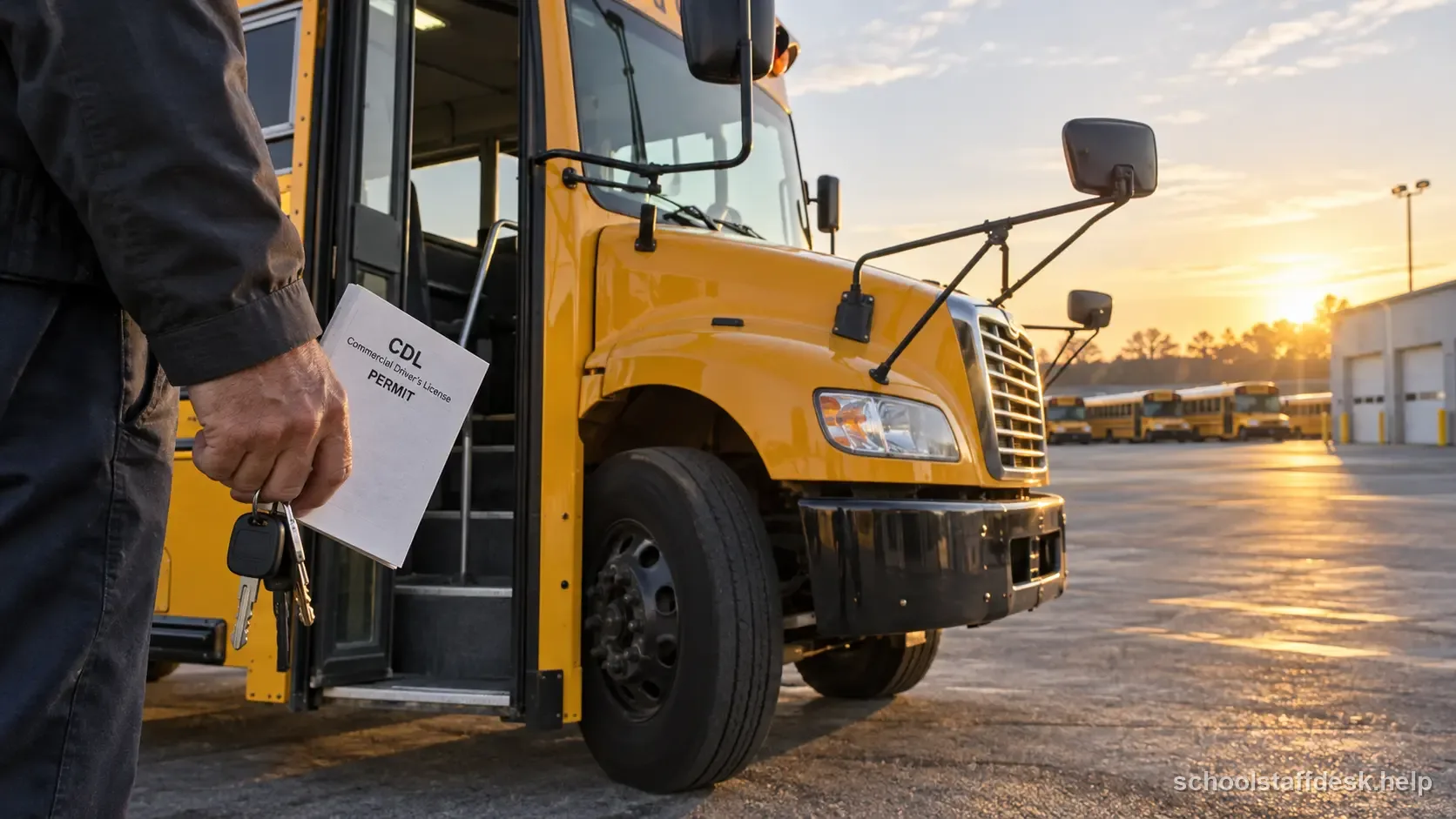
The two federal endorsements you actually need
Start with the vehicle and operation. Federal CDL rules generally cover a vehicle designed to carry 16 or more people including the driver, or a vehicle with a gross vehicle weight rating of 26,001 pounds or more; states can impose additional requirements. When CDL rules apply and a driver operates a qualifying school bus carrying school students, federal rules require the Passenger (P) and School Bus (S) endorsements. FMCSA says both are not required for every empty-bus movement or unrelated trip, so clarify the planned duty with the state driver-licensing agency.
The S endorsement requires a school-bus knowledge test and skills test under federal CDL rules. State licensing agencies administer testing and may add school-bus-specific training or certification. Check the state CDL manual and ask the employer which license class, endorsements, restrictions, and state certificate match the bus you would drive.
- Start with the passenger endorsementThe article says the school bus endorsement requires the passenger endorsement first.
- Complete required entry-level trainingCheck whether ELDT applies to your credential path.
- Clear medical and drug-testing stepsComplete the required checks before driving.
- Keep credentials currentTrack ongoing requirements after qualification.
Entry-level driver training requirement
ELDT generally applies to a person seeking a Class A or B CDL for the first time, upgrading from Class B to Class A, or obtaining an S or P endorsement for the first time. Required training must be completed through an FMCSA Training Provider Registry provider before the applicable skills test. The rule is not retroactive for a CDL or relevant endorsement issued before February 7, 2022, and federal exceptions may apply.
Before enrolling, use FMCSA’s current ELDT applicability guidance to check your exact scenario, including any existing CDL/endorsement or exception. Then search the Training Provider Registry and confirm with your state licensing agency which theory and behind-the-wheel elements it will verify. State requirements can go beyond the federal minimum.
The medical and drug-testing requirements
Do not assume every school bus driver must carry the same federal DOT medical certificate. FMCSA’s operational safety rules include exceptions for school bus operations and government transportation, while states may impose their own medical standards, especially for intrastate school-bus driving. Ask which rule applies to your route and whether the state or employer requires a medical examination, who may perform it, and when it must be renewed.
Federal CDL drug-and-alcohol testing rules can apply to drivers of vehicles requiring a CDL, including government-employed drivers, unless a specific exception applies. Covered employers generally administer required pre-employment and random testing, with other testing triggered under the governing rules. Ask whether the employer places this position in a DOT testing program and distinguish DOT tests from any additional district screening.
What to expect if you're considering the role
Ask the transportation department or contractor for a written sequence: learner’s permit, required credentials and endorsements, ELDT if applicable, state tests, state school-bus training or certificate, medical clearance if required, and background or driving-record checks. Ask which steps you must complete before applying and which the employer supports after a conditional offer.
Training support varies. Some employers advertise paid training or help with licensing; do not assume this is standard. Before paying a provider, confirm the employer accepts it and that it appears in the FMCSA registry if ELDT applies. Ask about training costs, wages during training, reimbursement terms, and any repayment agreement.
The federal requirement stack for school bus drivers
| Requirement | What it covers |
|---|---|
| CDL class, if applicable | Depends on vehicle design/weight and state requirements; verify the bus and operation. |
| P and S endorsements, if applicable | Federal school-bus operation rules can require both for a CDL driver carrying school students. |
| ELDT, if applicable | Trigger depends on first-time CDL/endorsement status and federal exceptions; use a TPR provider. |
| Medical clearance | Federal school-bus exceptions and state intrastate rules matter; confirm with the licensing agency. |
| Drug and alcohol testing | Federal Part 382 may cover CDL-required drivers, including government employees; verify the role. |
- Before trainingConfirm endorsement prerequisites and whether ELDT applies.
- During qualificationComplete driver training and required testing.
- Before drivingMeet medical and drug-testing requirements.
- After credentialingMaintain the ongoing requirements described for the role.
What a typical training timeline actually looks like
There is no reliable nationwide timeline: state testing availability, provider schedules, background-clearance processing, and employer training differ. Ask the licensing agency and employer for their current processing estimates and application order. Do not schedule a road test until the state confirms that required training, permit holding periods, and prerequisites are complete.
Keep copies of training completion records, test results, medical documents if required, and each license or endorsement. Confirm which restrictions apply to the license you receive, such as vehicle class or intrastate operation, before accepting a route. A credential for one bus type or operation may not authorize another.
Ongoing requirements after you are fully credentialed
After hiring, keep your license class, endorsements, state school-bus credentials, and any required medical certification current. The renewal interval and driving-record standards depend on the credential and jurisdiction. Covered CDL drivers also remain subject to applicable drug-and-alcohol testing rules. Ask who tracks renewal dates and what you must report if a license, medical status, or driving record changes.
Do not assume the employer will alert you to every deadline. Maintain your own copies and verify your status with the licensing agency before driving after a credential expires, a restriction changes, or an endorsement is removed. Follow the employer’s safety and reporting policies for incidents and testing.
Sources used for this guide
- FMCSA — Information for School Bus Operators
- FMCSA — Commercial Driver Requirements and Endorsements
- FMCSA — Entry-Level Driver Training
- FMCSA — Drug and Alcohol Testing Applicability
Rules can change. Use these sources as a starting point and confirm any state, district, student-plan, employment, licensing, or retirement requirement with the agency or team that governs your situation.
Questions school staff ask about this situation
What license do you need to drive a school bus?
It depends on the vehicle and state. Federal CDL rules may require a particular CDL class and, for qualifying school-bus operations carrying students, P and S endorsements. Check the state driver-licensing rules for the specific vehicle and route.
Do school bus drivers need special training beyond the CDL test?
ELDT applies to defined first-time CDL, upgrade, and first-time P/S endorsement scenarios, subject to exceptions. Check FMCSA’s current applicability guidance and use a Training Provider Registry provider when required.
Do school bus drivers get drug tested?
Federal testing rules generally apply to drivers operating CDL-required vehicles, including government employees, unless an exception applies. The employer can confirm whether this specific position is covered.
Is a regular DOT physical enough, or do school bus drivers need something more?
Not always under one federal rule. School-bus and government operations can be excepted from some federal motor-carrier safety standards; state requirements may still require a medical exam. Verify the route and state rule.