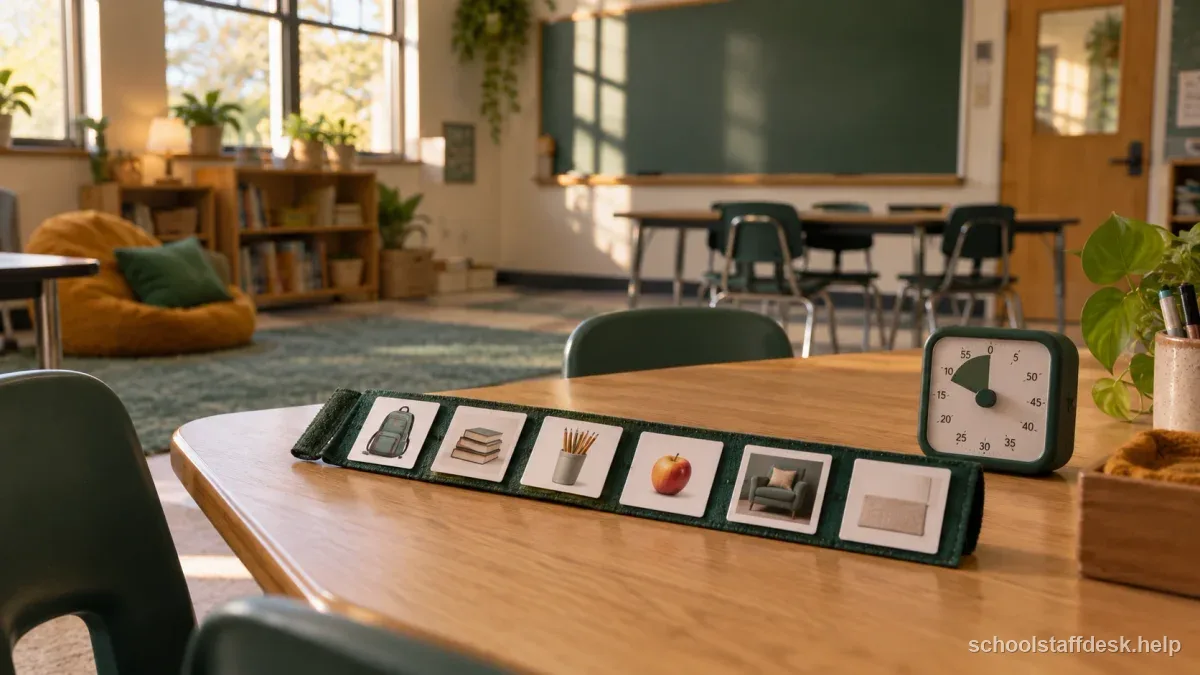
Your first ten questions matter more than your first ten tasks
Before trying to be useful, ask who directs your work, which students or groups you are assigned to, what the daily schedule is, where you should be during arrival and dismissal, and what classroom routines you are expected to reinforce. Then ask which student plans you need to understand, what emergency procedures apply, who handles health-related tasks, and what to do when the lead teacher is absent.
Write the answers. A special-education classroom can change quickly because of therapies, services, transportation, behavior supports, and staffing. Memory is a poor substitute for a schedule you can actually check.
First-day para briefing card
- Ask for your schedule, student assignments, emergency procedures, health alerts you are authorized to know, and the name of the person who directs your work.
- Read the accommodations and behavior supports you are expected to implement before the first high-demand activity.
- Learn the classroom's reinforcement, prompting, break, and transition routines so your help matches the teacher's system.
- Clarify toileting, feeding, mobility, medication, and crisis procedures before assisting with any task that requires training.
- Carry a small note system for observations and questions instead of trying to remember the whole day.
Read the parts of plans that change your behavior today
If you are expected to implement accommodations, prompting procedures, communication supports, behavior strategies, toileting routines, mobility assistance, or data collection, ask to review the relevant information through the district’s approved process. You do not need unrestricted access to every student record; you need the information required to perform your assigned educational responsibilities.
Ask what success looks like for each support. “Help with reading” is vague. “Pause for the response window in the plan, point to the visual cue, then use the agreed verbal prompt if needed” is something two adults can do consistently. IDEA requires paraprofessionals assisting with special education to be appropriately trained and supervised under state law, regulation, or written policy (34 CFR 300.156(b)(2)(iii)), so "help with reading" should arrive from the teacher as a defined procedure, not be left for you to invent.
Do not learn medical or physical-care procedures by watching once
Feeding, medication, seizure response, diabetes care, lifting or transferring, toileting, restraint, seclusion, and other health or safety procedures can involve training, delegation, state law, district policy, or an individualized plan. Rules differ by task and state. If you have not been trained or authorized for a task, say so before it becomes urgent and contact the nurse, therapist, administrator, or trained staff member responsible for clarifying the procedure. Do not infer authorization from having watched someone else do it once.
Being willing to help is not the same as being qualified to perform a medical or safety procedure. A good team would rather clarify the role at 8:00 a.m. than discover the gap during an emergency. If you are assigned one-to-one to a student, confirm that the assignment comes from the IEP and ask what it is meant to fade toward, because a permanent adult at the elbow can suppress exactly the independence the plan is trying to build.
Learn the classroom's prompting and break language
Ask how students request breaks, what prompts the team uses, what reinforcement system is in place, and how adults respond to refusal or escalation. If every adult uses different words and different levels of help, students receive an inconsistent environment and the team cannot tell which support is working.
Observe before changing the routine. A strategy that looks unusual may be tied to an IEP, behavior plan, communication system, or therapist recommendation. Bring questions to the lead teacher privately instead of correcting another adult in front of students.
Keep a small observation system, not a secret notebook
Use the data sheet, digital system, or quick tally method the team has assigned. If you need a temporary reminder for questions, keep it secure and transfer the relevant information into the approved record or conversation. Do not build a personal archive of student behavior, health, or disability information that follows you home.
Useful notes are objective: time, task, observable response, prompt level, frequency, duration, or the specific unusual condition that affected the session. Opinions about motives belong in discussion, not in raw data.
Keep a clean observation notebook and finish with a five-minute debrief
Carry a small work notebook or approved digital note system for operational questions: Which transition is hardest? What prompt does the teacher use before independent work? Where does completed data go? Who covers the student when you take a break? Which task requires nurse training? Avoid creating a personal shadow file of diagnoses, family history, or sensitive student details. If information belongs in an education or health record, use the district’s approved system and access rules.
At midday, check three things with the lead teacher: whether your level of help is appropriate, whether any safety or behavior procedure was unclear, and whether you missed a scheduled service or data task. That five-minute calibration is more useful than waiting until Friday to discover that you were overprompting or collecting the wrong measure.
At dismissal, separate what you observed from what you inferred. ‘Needed a verbal prompt on four of five transitions’ is useful. ‘Was lazy after lunch’ is not. Clean observations help the teacher decide what to change; labels tend to harden into stories that are difficult to verify.
Ask the lead teacher what you did that was helpful, what should change tomorrow, and which routines you still need to learn. Clarify any moment when you were unsure whether to step in or back away. If a safety or health issue came up, make sure the event was documented through the proper system before leaving.
Your first-day goal is not to prove you can handle every student alone. It is to become a predictable member of the team who follows plans, asks before crossing a boundary, and makes the classroom easier to run on day two.
- Check the level of helpAsk whether your prompting matched the student's plan.
- Review unclear proceduresRaise safety, behavior, or health questions with the lead teacher.
- Confirm assigned workCheck whether a service or data task was missed.
- Separate observation from inferenceShare observable actions, not labels about motives.
Sources used for this guide
- Nebraska Department of Education — Paraeducator Guidance Document
- U.S. Department of Education — IDEA
- U.S. Department of Education — Emergency Planning
- IDEA regulation §300.156 — Personnel qualifications
Rules can change. Use these sources as a starting point and confirm any state, district, student-plan, employment, licensing, or retirement requirement with the agency or team that governs your situation.
Questions school staff ask about this situation
What should a para ask on the first day in a special-education room?
Ask who directs your work, your schedule, assigned students or groups, relevant IEP and behavior supports, emergency procedures, health-task boundaries, data expectations, and who to contact when the lead teacher is unavailable.
Should a para read every student's full IEP?
Access should match the para’s assigned educational responsibilities and district policy. Review the information you need to implement supports correctly and ask the teacher or case manager when something is unclear.
Can a para perform medical or physical-care tasks?
Only when the task is permitted, assigned, and supported by the required training, delegation, or plan. If you are unsure, stop and ask the school nurse or responsible supervisor before acting.
What should I do if adults in the room use different behavior strategies?
Do not choose your favorite in the moment. Ask the lead teacher how the team is supposed to respond so support is consistent with the student plan and classroom system.