
Why licenses lapse in the first place
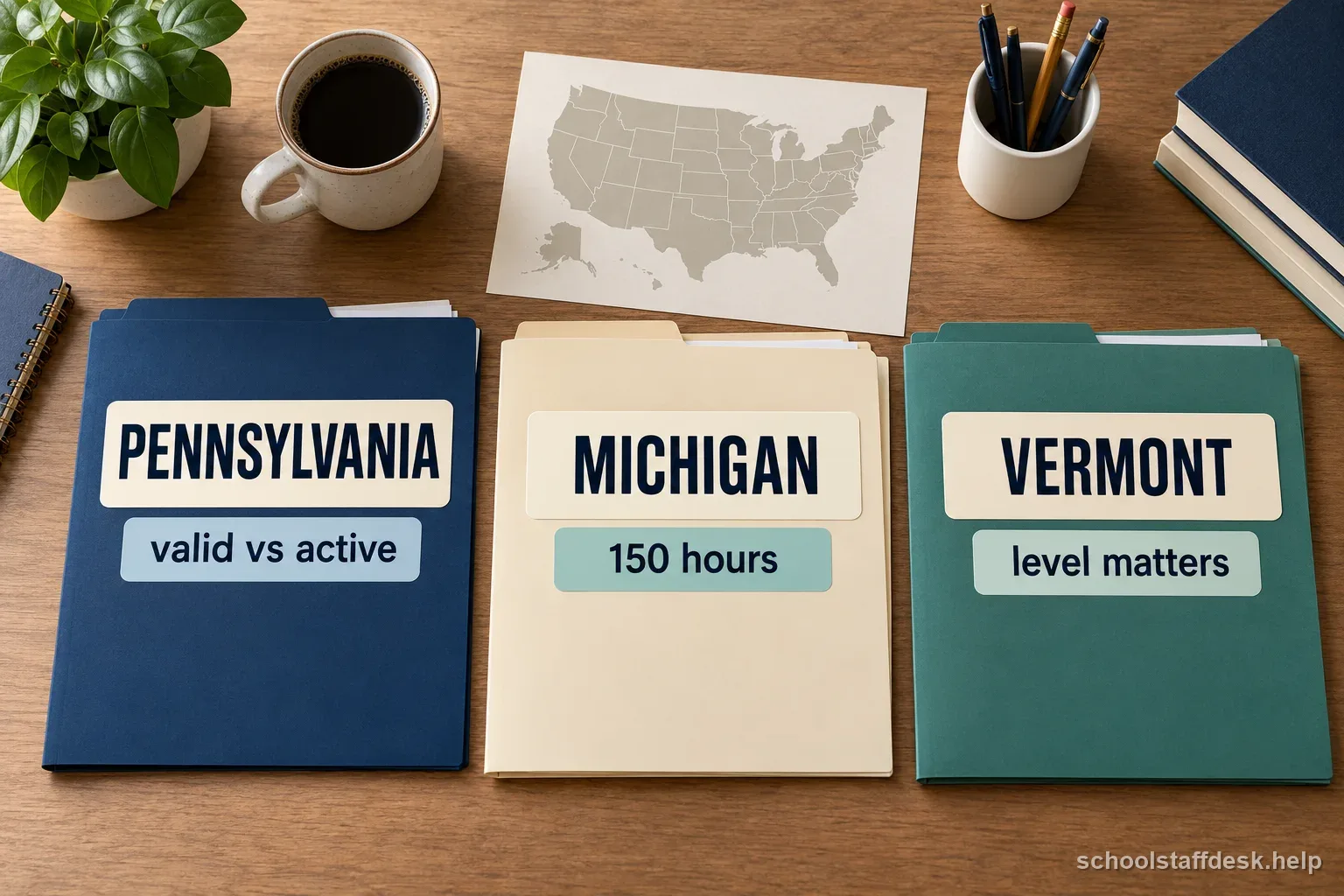
Credential names and expiration rules differ. A state may distinguish an unexpired credential from one that is active for a particular type of public-school employment; another may use different status labels or renewal cycles. For example, Pennsylvania distinguishes valid from active status and ties active public-school certification to its Act 48 continuing-education rules. Do not assume your state uses the same vocabulary.
Look up the actual record in the issuing agency’s system and save the credential type, endorsements, expiration date, and status wording. If the lookup is unclear, ask the licensing office which rule and application apply to your exact credential. A district job posting or an old paper certificate may not show the current status.
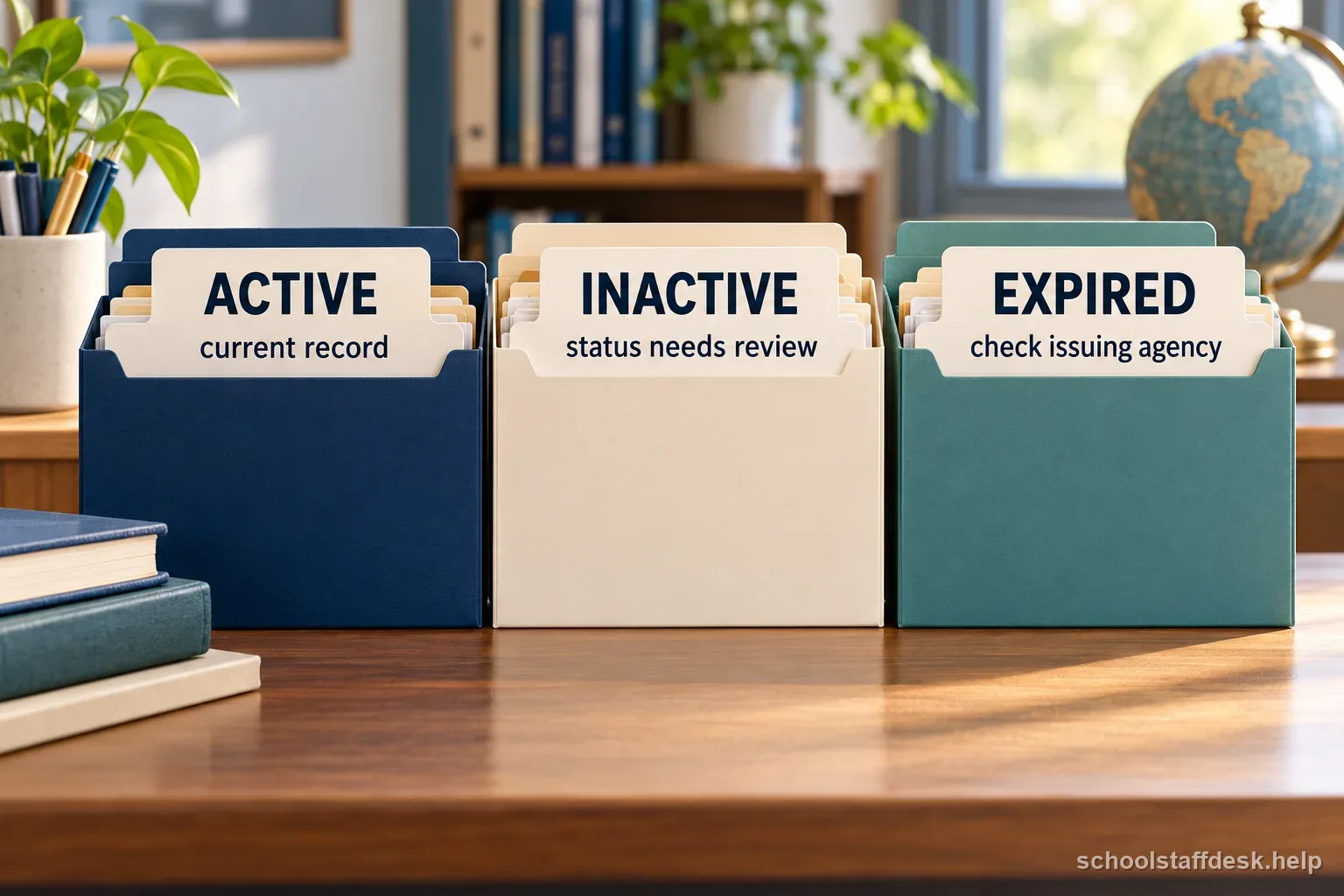
A career break alone does not tell you which route applies. Some states separate an expired certificate from an inactive one, and a license may have different validity and employment statuses. Save a dated copy of the official record and ask which exact status controls your intended public-school role.
What reinstatement commonly requires
There is no single reinstatement checklist. The state may direct you to ordinary renewal, reactivation of an inactive certificate, or a distinct reinstatement route. Depending on the credential and status, it may require continuing education, coursework, an application, an exam, proof of recent experience, or a fee. A background check may be part of employer hiring or a state credential process, but it is not safe to assume every license reinstatement requires one.
Official state examples differ: Pennsylvania says educators with an inactive certificate must meet remaining Act 48 requirements and report them through PERMS for status to return to active. Vermont’s current page requires Level I endorsement holders to complete three credits (45 hours) of new professional learning per endorsement, with at least one credit (15 hours) directly tied to the endorsement. Vermont specifies different requirements for Level II. These examples do not apply outside their credential systems.
Michigan gives another bounded example. If a Michigan certificate expired and the educator does not hold a valid out-of-state certificate, the state lists 150 education-related professional learning hours for renewal. A valid out-of-state certificate changes that route. Ask the Michigan Department of Education which activities it accepts before paying for a course.
| State | Published example | What to verify |
|---|---|---|
| Pennsylvania | Valid and active are separate statuses | Check validity and Act 48 status separately |
| Michigan | Expired, no valid out-of-state: 150 hours | Ask which learning activities count |
| Vermont | Level I: 3 credits or 45 hours per endorsement | Confirm license level and endorsement |
| Arizona | Route depends on expiration period and service | Check current clearance and application path |
State examples show why you need the exact route
Do not rely on a generic article’s credit-hour figure, fingerprinting advice, or statement that a test is required. The same state can have different pathways by credential level, endorsement, date issued, or current status, and the agency may revise a pathway. Check the exact form and rule linked from your state’s official educator licensing page before enrolling in a course or paying an application fee.
If you hold a current credential from another state, ask whether it can support reactivation or a new in-state application. Reciprocity for an active full teaching license is a separate question from reinstating an old in-state credential, and neither guarantees immediate hiring.
Arizona also separates pathways by how long a certificate has been expired and the educator’s Arizona teaching history. Its under-one-year route lists a valid state fingerprint clearance card, documented professional development, an application, and a fee. That is an Arizona example, not a nationwide fingerprint rule. Check the current agency route for your certificate before making plans.
- Confirm the license recordFind out whether the credential is active, lapsed, or subject to reinstatement.
- Identify the state routeCheck current state requirements before relying on another state’s example.
- Plan the return sequenceResolve coursework or testing, then check whether a background refresh is also due.
Practical steps if you're considering coming back
First, identify the issuing authority and use its credential lookup. Then ask which route applies—renewal, reactivation, reinstatement, or a new application—and request the current checklist, deadlines, fees, and processing instructions. Ask whether graduate coursework, professional learning, teaching elsewhere, or another state’s active license can count. Get answers in writing when the route affects your eligibility or cost.
The guide to service credit can help you organize pension records if your break also paused public employment. The pension system’s own estimate controls any benefit calculation.
Next, ask district HR what is separate from state licensure: application documents, background-clearance steps, references, orientation, and whether the role or school type requires a particular endorsement. State approval may be necessary without being the only hiring condition. Do not begin teaching until the responsible agency and employer confirm you are authorized for that assignment.
A concise first message can say: ‘I previously held [credential and endorsement], last renewed in [year], and plan to teach [grade or subject] in [state]. The public record now says [exact status]. Which application and requirements apply, and where is the current checklist?’ Do not include a Social Security number or identity documents unless the agency requests them through its secure system.
| Office | Ask about | Keep on file |
|---|---|---|
| State licensing agency | Credential status, route, accepted learning | Current record and written checklist |
| District HR | Role clearance, onboarding, start date | Clearance instructions and confirmation |
| Pension system, if relevant | Return-to-work effect on retirement status | Official estimate and service record |
What to do if you're not sure whether your break affected your license status
If the public lookup does not show a record or uses an unfamiliar status, contact the issuing agency with your certificate number, credential name, endorsements, and last renewal date. Ask whether a status change affects only public-school employment, whether you can apply to reactivate it, and which requirements remain outstanding. Avoid sending identity documents by ordinary email; use the agency’s secure application system when requested.
Make a simple return plan that lists each official step, its source page, due date, fee, and any proof you need to keep. Do not pay for a course until the licensing office confirms it is accepted for your specific credential and status. This avoids spending time on general professional development that may not satisfy a formal reinstatement requirement.
For example, a Pennsylvania educator whose certificate is valid but inactive should not assume the certificate has expired. PDE distinguishes the two statuses and describes an Act 48 route for reactivation. The returner should check the current PERMS balance and the certificate’s validity separately before choosing coursework or an application.

Steps to check before returning to teaching after a break
- Look up the credential and endorsements in the issuing authority’s official record.
- Determine whether your license is 'expired' (not renewed) or 'inactive' (a different status in some states) — the reinstatement path can differ.
- Get the current checklist, fees, deadlines, and accepted coursework directly from the licensing agency.
- Confirm separately with district HR which clearances and onboarding steps the position requires.
- If you moved states, ask the destination agency whether your credential or prior records support its application route.
- Confirm the employer has cleared your specific role before the first day.
What to expect if you also need a background check refresh
Check whether a background clearance is required for license restoration, for district employment, or for both. The responsible agency, accepted clearance type, and renewal timing depend on the jurisdiction and employer. If the district requires fingerprints or another check, follow its authorized vendor and submission instructions rather than assuming an old clearance transfers.
If you moved or plan to teach in another state, ask each relevant state agency which records it needs and whether a prior license or clearance can be verified electronically. Keep confirmation numbers and receipts, and allow the actual processing time stated by the agency. A credential restoration and an employment background check are separate approvals unless the agencies explicitly say otherwise.

Refresh your classroom routines while the paperwork moves
A credential decision does not refresh a lesson plan, district platform, or school procedure. Once the employer confirms the role and start date, ask which curriculum materials, learning-management system, attendance process, grading rules, and student-support plans you will use. Request an orientation or a current staff handbook instead of relying on notes from your last school.
Choose a focused re-entry plan for the first month. Review the grade-level standards and current course sequence, practice the district’s digital tools, and ask who can answer questions about behavior, accommodations, and family communication. If a short-term assignment is a permitted route in your state, ask HR how its credential and onboarding requirements differ. A refresher course may help your practice, but it does not replace state approval or employer clearance.
If you are moving across districts, verify the new employer’s requirements as a separate step. Prior service, license status, and hiring clearance can follow different rules.
If prior service affects your eligibility or placement, the teacher tenure guide explains which records to gather before asking HR for a written determination.
Sources used for this guide
- Pennsylvania Department of Education — Return to Teaching
- Vermont Agency of Education — Reinstate Your License
- Michigan Department of Education — Return to the Profession
- Arizona Department of Education — Teach Again
Rules can change. Use these sources as a starting point and confirm any state, district, student-plan, employment, licensing, or retirement requirement with the agency or team that governs your situation.
Questions school staff ask about this situation
Does a lapsed teaching license mean I have to start certification over from scratch?
A career break does not automatically mean repeating teacher preparation, but the answer depends on your credential and state. Check whether the agency requires renewal, reactivation, reinstatement, or a new application.
What's the difference between a license being 'expired' and 'inactive'?
Those labels are state-specific. A state may distinguish a certificate that remains valid from one active for employment, while another may use different terms. Use the issuing agency’s definition for your exact credential.
How much continuing education do I need to reinstate a lapsed license?
There is no national number. Michigan lists 150 professional-learning hours for one expired-certificate route, while Vermont sets requirements by license level and endorsement. Verify the current rule for your own record before enrolling.
Will I need a new background check to return to teaching?
It depends on whether the state ties clearance to license restoration and what the employing district requires. Ask both offices; do not assume a prior clearance transfers or that every reinstatement requires a new one.