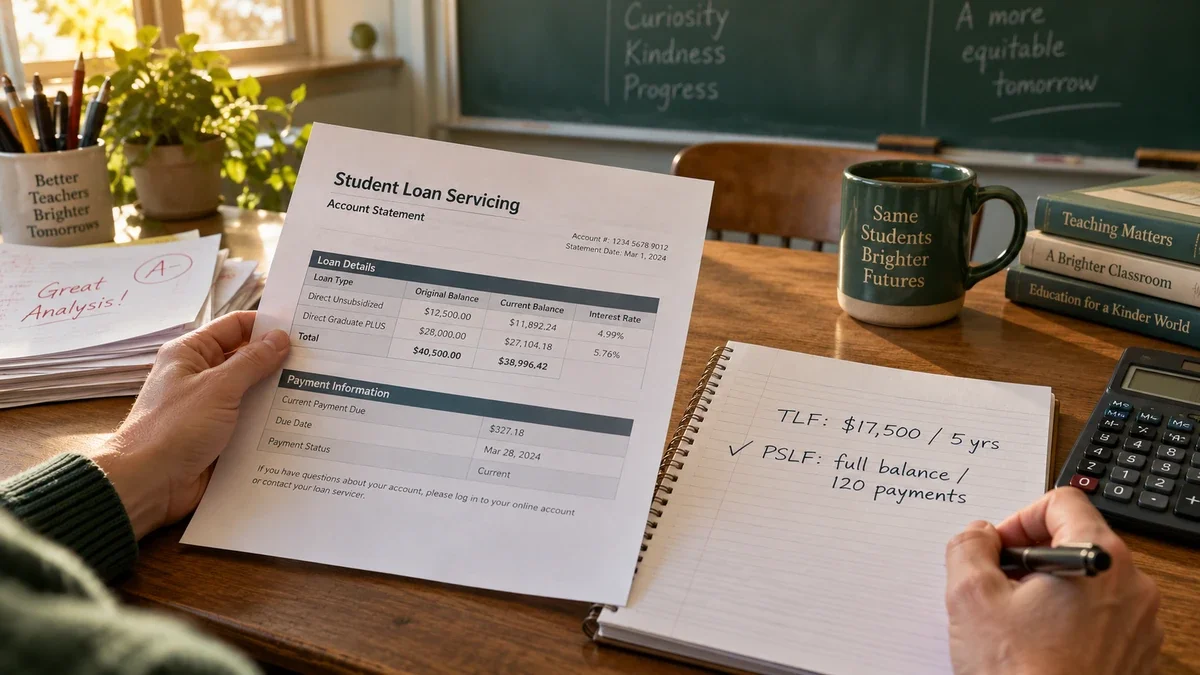
What Teacher Loan Forgiveness actually requires
TLF forgives up to $17,500 of Direct or FFEL Subsidized or Unsubsidized loans after five complete, consecutive academic years of full-time teaching at a qualifying low-income school or educational service agency. The $17,500 maximum is reserved specifically for highly qualified secondary math or science teachers and special education teachers at any level; every other qualifying subject area caps out at $5,000. To count as "highly qualified" you need a bachelor's degree, full state certification, and no emergency, provisional, or temporary certificate during the five years being counted.
The five years have to be consecutive at qualifying schools, though a partial year missed for certain documented reasons (like medical leave) can sometimes still count — check the current Federal Student Aid guidance before assuming a gap year resets your clock. Both Direct Loans and FFEL loans are eligible for TLF, which is broader than PSLF's loan-type requirement.
What PSLF actually requires, and how it differs
PSLF forgives your entire remaining Direct Loan balance after 120 qualifying monthly payments (10 years, though not necessarily consecutive) made while working full-time for a qualifying public service employer — which includes essentially any public school district and most nonprofit private schools. Unlike TLF, PSLF does not require you to teach a specific subject, does not require your school to serve low-income students, and does not require five consecutive years in a row; a scattered 10 years across multiple qualifying public-sector jobs still counts, as long as each payment period is documented as full-time qualifying employment.
PSLF also only accepts Direct Loans — if you have older FFEL loans, they must be consolidated into a Direct Consolidation Loan before those payments start counting toward your 120, and that consolidation resets your payment count to zero for the consolidated portion.
The sequencing problem: you cannot double-count the same payments
This is the detail that trips up the most teachers: if you complete five years of qualifying teaching and receive TLF forgiveness on your Direct Loans, any payments you made on those loans during that five-year window cannot also be counted toward PSLF's 120-payment requirement. In practice this means pursuing TLF first can cost you five years of PSLF progress you would otherwise have banked for free while your loans were in repayment anyway.
For a teacher with a federal loan balance well above $17,500, running the PSLF clock from year one — filing the PSLF employment certification form annually and making income-driven repayment plan payments the whole time — usually produces far more total forgiveness than diverting five years toward the smaller TLF payout first.
TLF vs. PSLF at a glance
| Teacher Loan Forgiveness | PSLF | |
|---|---|---|
| Forgiveness amount | Up to $17,500 (or $5,000 depending on subject) | Entire remaining balance |
| Time required | 5 consecutive years teaching | 120 payments (10 years, not necessarily consecutive) |
| School requirement | Must serve low-income students | Any public school or qualifying nonprofit employer |
| Subject requirement | $17,500 tier limited to math/science/special ed | None |
| Eligible loans | Direct and FFEL | Direct only (FFEL must be consolidated first) |
When TLF is still the better choice
TLF makes more sense when your loan balance is close to or below the $17,500 (or $5,000) cap, when you are not confident you will stay in public-sector teaching for the full 10 years PSLF requires, or when you already have five years of qualifying low-income-school teaching completed and simply haven't applied yet — that forgiveness is sitting on the table with no further waiting required. TLF also does not require the ongoing annual paperwork and employer certification that PSLF does, which matters if you have moved between districts or states and certification records have gotten messy.
A worked example
Consider a special education teacher who graduated with $60,000 in Direct Loan debt and plans a full 30-year career in public schools. If she pursues TLF first, she gets $17,500 forgiven after 5 years but starts her PSLF clock from zero afterward, needing another 10 years of qualifying payments to clear the remaining roughly $42,500-plus balance (which will have accrued interest during those first 5 years unless she was also making payments). If she instead enrolls in an income-driven repayment plan and files PSLF employment certification from year one, her full remaining balance is forgiven after 10 years total — 5 years sooner than the TLF-then-PSLF sequence, and without leaving $17,500 in interest-accruing balance sitting untouched during the TLF years.
This example is illustrative, not universal — a teacher with a smaller loan balance, or one genuinely uncertain about staying in public education for a full decade, may still find TLF's faster, smaller payout the more sensible bet. Run your own numbers against your specific balance, interest rate, and career plans rather than defaulting to either program.
Where to actually check your progress
For PSLF, submit the PSLF Employment Certification Form annually, even though it's not strictly required every year, because it catches employer eligibility problems early rather than at year 10 when a mistake is far more costly to discover. Your loan servicer's PSLF tracker should reflect an updated qualifying payment count after each certification is processed; if it doesn't move as expected, follow up rather than assuming it will self-correct. For TLF, there's no annual certification — you apply once, after your five consecutive qualifying years are complete, using the Teacher Loan Forgiveness Application signed by your school's chief administrative officer.
What to do right now if you're not sure which path you're on
Pull your current federal loan balance and loan type (Direct vs. FFEL) from your servicer's dashboard, and check your PSLF payment count on the Federal Student Aid PSLF tracker if you have one — many teachers discover they've already been making qualifying PSLF payments for years without ever filing an employment certification form, which means those payments may not have been counted yet even though the work itself qualified. Filing the certification retroactively for prior qualifying employment is possible and worth pursuing before assuming any progress is lost.
Sources used for this guide
- Federal Student Aid — 4 Loan Forgiveness Programs for Teachers
- Federal Student Aid — Teacher Loan Forgiveness Application
- NEA — Frequently Asked Questions on Student Loan Forgiveness
Rules can change. Use these sources as a starting point and confirm any state, district, student-plan, employment, licensing, or retirement requirement with the agency or team that governs your situation.
Questions school staff ask about this situation
Can I do TLF and then start PSLF afterward?
Yes, but the five years of payments used toward TLF forgiveness cannot also count toward your 120 PSLF payments. You would effectively be starting your PSLF clock fresh after receiving TLF forgiveness, which is why sequencing matters for anyone planning to stay in public education long-term.
Do I need to pick one program and stick with it from day one?
Not necessarily, but the interaction between the two means it's worth calculating your specific loan balance and expected career length before choosing. A teacher planning a full career should generally lean toward running the PSLF clock from the start rather than delaying it for TLF.
Does National Board Certification or advanced degrees affect either program?
Neither program's forgiveness amount changes based on National Board Certification or advanced degrees. Both are separate from state-level salary schedule benefits those credentials may unlock.
What happens to my PSLF progress if I leave teaching for a private-sector job for a few years?
PSLF qualifying payments only accrue while working full-time for a qualifying public service employer, so payments made during private-sector employment don't count toward the 120, though they also don't erase payments you already banked — your progress simply pauses and resumes when you return to qualifying employment.